Christine de Pizan

Christine de Pizan
The Writer Christine de Pizan at Her Desk
Showing posts with label Encyclopedia Britannica. Show all posts

Sunday, November 27, 2022

Galla Placidia, "the Last Roman Empress"

Galla Placidia, queen of the Visigoths, empress of Rome, regent of the empire (died 27 November 450)


Galla Placidia, the woman who would become queen of the Goths, then empress of the western Roman empire, and ultimately regent of the empire, was the granddaughter, daughter, sister, and mother of emperors of Rome.

Her father was Theodosius I, "the Great," a Roman soldier who rose through the ranks and eventually became emperor, ruling from 379 to his death in 395. 

A gold tremissis, 5th century,
Galla Placidia
Placidia's mother was Emperor Theodosius's second wife, Galla, the daughter of Valentinian I, who had become emperor in 364--Valentinian had split the Roman empire, ruling the western part himself until his death in 375, and appointing his brother, Valens, as emperor in the east. So, Placida is also the great niece of an emperor.

Placidia's half brothers, born to Flavia Flacilla, the first wife of Theodosius, were Arcadius and Honorius. After the death of Theodosius in 395, both men became emperor, Arcadius in the East, Honorius in the West. 

Placidia was born during the last decade of the fourth century, her life and career spanning what her biographer Joyce Salisbury calls "the twilight of the empire." (While we have come to think that the "fall of the Roman Empire" occurred in the fifth century, what "fell" then was the western part of the empire--in the east, the empire persisted until 1453, when Constantinople fell to the Turks.) 

Although the year of her birth is not known, Theodosius and Galla were married in 386 or 387, and a son, Gratian, was born in 388. Galla died giving birth to a son in 394, thus providing the few years between 388 and 394 as the time for Placidia's birth. (Theodosius was campaigning in Italia between 388 and 391, while Galla remained in Constantinople--their separation may indicate more about the possible year of Placidia's birth.)

After the death of her mother in Constantinople, Placidia may have been summoned to Milan; whether she was there at the death of her father in 395 isn't certain. But she seems to have spent some time in Ravenna, at the court of her half-brother Honorius. The military commander Stilicho was guardian of the underage Honorius, while Placidia was in the care of Stilicho's wife, Serena, who was Placidia's cousin. Placidia seems also to have been supposed to marry Eucherius, the son of Stilicho and Serena.

Under Serena's guardianship, Placidia resided in Rome while Stilicho campaigned against the Franks, Vandals, and Goths, among other would-be invaders, but he was ultimately brought down by his own troops, who mutinied in 408. Suspicious of Stilicho's intentions, Honorius ordered his execution. 

Meanwhile, under Alaric, the Goths invaded the Italian peninsula and began a siege of Rome, which was sacked in August 410. During the siege, Serena was accused of conspiring with Alaric and, with Placidia's consent, Serena was executed in 409. The exact circumstances surrounding Placidia's "consent" are not clear, and contemporary accounts differ.

Equally unclear is what happens next: Placidia is married to Alaric's successor, Athaulf, now king of the Visigoths. Well, the marriage itself is clear enough--Placidia was taken to Gaul, and in 414, she was married "in a Roman wedding ceremony" to Athaulf in Narbonne. 

What is not clear is, once again, the context of Placidia's situation--Placidia was variously said to have been "captured" or "abducted" or taken hostage by Alaric in 410, but then again she may have been traded to Alaric by Honorius as part of some kind of deal. In any case, Alaric died in Italy not long after the sack of Rome, and by 412, Placidia was in Gaul.

As for the marriage. According to some sources, Honorius refused to consent to any marriage between Placidia and Athaulf, but Placidia herself "fell in love" with Athaulf and married him. Other sources attribute the match not to love but to power and politics: the marriage took place only after Athaulf captured and killed two rivals claiming Honorius's title as emperor, who then rewarded Athaulf with the alliance. Or maybe it was Placida herself who negotiated the treaty between the two men.
Gold solidus,
Constantinople, 423-29, 
Galla Placida

Whether Placidia is the reason for Athaulf's alliance with Honorius or a prize for Athaulf's dispensing of the rivals to Honorius's imperial title, the marriage did not last long. By 415, Athaulf was assassinated. Athaulf's six children by his first wife were killed, but Placidia, once more a captive, survived. (Placidia was childless. She had given birth to a son, named Theodosius after her father, shortly after her marriage, but the boy had died a few months later.) 

By 416, Placidia was returned to Honorius by Athaulf's successor, Wallia, as part of a peace negotiation. (According to at least one account, the desperate Goths exchanged their imperial "hostage" for food, but another claims that the Goths held onto Placidia until they received a sizeable payment for their hostage in grain.) 

Although she seems to have wished to remain a widow, Placidia was soon compelled by her brother to marry Constantius, the Roman general to whom Wallia had surrendered in 417. She gave birth to two children, a daughter, Justa Grata Honoria (b. c. 418), and a son, Valentinian (b. 2 July 419). 

On 2 September 421, the childless Honorius named Constantius co-ruler of Rome, but he died just months later, on 2 September. The widowed Galla Placidia, who had been proclaimed augusta when her husband had been given the title augustus, was at first criticized for being scandalously close to her brother. But however close their relationship, scandalous or not, might have been, by 422 Placidia and her children were in Constantinople with her nephew, Theodosius II. Honorius may have been fearful of Placidia's influence with the Goths and sent her to Constantinople or, fearful of her half-brother, Placidia may have fled, finding safety with her nephew. Accounts differ.

Galla Placidia Augusta remained in Constantinople with her two children until the death of Honorius in 423. Before Theodosius could name a successor emperor in the west, a usurper had claimed the title. After the usurping Joannes was defeated in 425, Placidia's six-year-old son, Valentinian, was proclaimed augustus, with Placidia serving as his regent.

Despite the rivalries among the influential generals Flavius Aetius and Bonifacius, Placidia's regency lasted for twelve years, until Valentinian reached his age of majority in 437. Although her power was diminished by Aetius's military and political success and her son's independence, she remained an influential figure in imperial politics until her death. 

Galla Placidia is buried in Rome, where she died on on 27 November 450. 
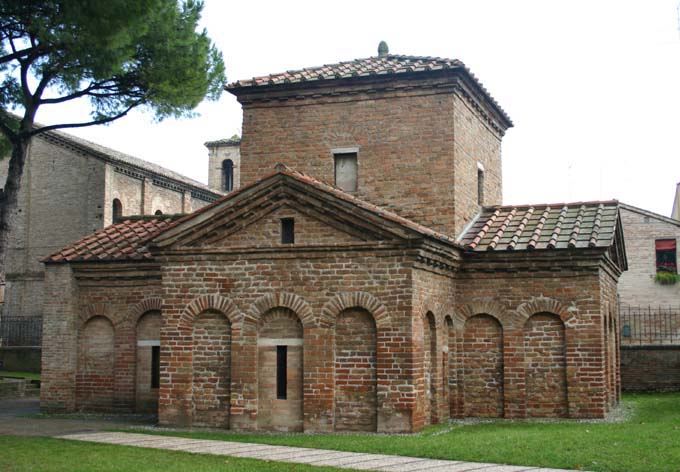
Mausoleum of Galla Placidia,
Ravenna

Beyond her political role, Placidia was devoted to her faith. She and Constantius played an active role in the papal succession crisis of 418, and she called together a synod of African bishops. (Two of her letters about this synod survive; for analysis of them, click here.) An orthodox Catholic, she was "vigorous in opposition" to the heresies of Pelagianism and Manicheism. She was also involved in the building of several churches in Rome and Ravenna, including the so-called Mausoleum of Galla Placidia, now a UNESCO World Heritage site, notable for its incredible mosaics. (I've linked here to the Wikipedia entry--it is the best overview available online.) 

There are two excellent recent biographies, Joyce Salisbury's Rome's Christian Empress: Galla Placidia Rules at the Twilight of the Empire and Hagith Sivan's Galla Placidia: The Last Roman Empress--I've used Sivan's subtitle here in the title of my post.

But there are also some excellent online sources. I particularly recommend the entry in Women in World History: A Biographical Encyclopedia (available here) and the entry from Roman Emperors: An Online Encyclopedia of Roman Rulers and their Families (available here).

And, given my on-going bitching about the Encyclopedia Britannica and its lack of women, I should note that there is at least a teeny tiny entry for Aelia Galla Placida. It mentions nothing at all about her role as regent. 


Friday, October 9, 2020

Harriet Hosmer: She "Knew Herself to be a Sculptor"

Harriet Goodhue Hosmer, American Sculptor (born 9 October 1830)


Harriet Hosmer, 
photo by Matthew Brady
The name of Harriet Hosmer came to my attention only recently--as part of the widespread protests in response to the murder of George Floyd, in particular, and to the growing resistance movement that addressed larger issues of police brutality, systemic racism, and social injustice. 

As statues honoring Confederate generals and white supremacy at long last began to come down, a monument that remained standing was Thomas Ball's Freedman's Memorial. 

While the intentions of those who worked to create a monument to Lincoln's emancipation of enslaved men and women may have been good, the memorial itself as long been a source of controversy: it might portray "the hopes, dreams, [and] striving" of those who constructed it, but it also represents the "ultimate failures of reconstruction."

Recognizing Ball's monument as a "problematic depiction of the fight to achieve emancipation," Congresswoman Eleanor Holmes Norton has said that she will introduce legislation to have the statue removed.

While the "great emancipator" might remain secure on his pedestal, at least for the moment, Ball's sculpture has undergone a new round of criticism for its imagery--a white man "giving" freedom to the unclothed black man kneeling at his feet. (For Patrick Browne's excellent essay on this "misguided" monument, written long before the events of this year, click here.)

The sculpture was funded by freed slaves, and while Frederick Douglas spoke at the monument's dedication, he later made it clear that his feelings were complex--Lincoln had issued the Emancipation Proclamation only reluctantly. Lincoln was neither the "man" nor the "model" for the struggle of those who had been enslaved. Later still, Douglas noted his reservations about the Ball design for the sculpture: “What I want to see before I die is a monument representing the negro, not couchant on his knees like a four-footed animal, but erect on his feet like a man.” 

So that was the context in which I first heard Harriet Hosmer's name--because Thomas Ball's was only one proposal for the memorial, one that was selected after Harriet Hosmer's original design was judged to be too expensive. Or perhaps too controversial.

In fact, Harriet Hosmer's 1867 design for the sculpture had been accepted by the commission overseeing the building of the memorial. Her proposal was not for a sculpture with one submissive freed slave at Lincoln's feet. Instead, it was a monument that featured Black Americans--above a base that depicted scenes from Lincoln's life, and posted around a Lincoln lying in his casket, were to be four "colossal statues" that "display the progressive stages of liberation" of African Americans: an enslaved man for sale, a slave "laboring on the plantation," a Black man aiding Union soldiers, and, finally, a Black soldier. In describing this figure, David Cranor writes, "The latter figure, standing with eyes gazing forward in uniform and holding a gun, would be shown having gained freedom, legitimacy and power."

But white members of the commission overseeing the monument insisted on a redesign--Lincoln lying in his coffin had to be swapped out with a standing Lincoln, the Emancipation Proclamation in one hand. Below him were four allegorical figures (female, of course), representing liberty. The Black men were retained, but they were bumped down, farther out and below Lincoln and the Liberties.

Harriet Hosmer's redesigned
proposal for the Freedman's Memorial
Eventually, of course, Ball's design, with the "figure of a liberated slave crouching below . . . Lincoln" was substituted for Hosmer's.

So who was Harriet Hosmer?

When fundraising began for this memorial, Harriet Hosmer was a already a well-established artist. As a girl, she had not only been allowed to pursue her interests in art, but her father encouraged her interest in anatomy. Her studies were informal at first, but she traveled to St. Louis for private instruction in anatomy at the Missouri  Medical College.

After returning to Boston, she left for Rome in 1852 with the actress Charlotte Cushman. Once there, she earned a place in the studio of John Gibson (along with several other American women, including Edmonia Lewis and Emma Stebbins, disparagingly referred to by the novelist Henry James as the "white marmorean flock"). In Rome, Hosmer was not only surrounded by classical sculpture, she was also able to work with live models, a rare opportunity for women artists. She also began a relationship with Louisa, lady Ashburton, a relationship that would last twenty-five years.

Hosmer had a long and successful career. She eventually returned to the United States and died in the place of her birth, Watertown, Massachusetts, on 21 February 1908.

Hosmer's Zenobia in Chains,
Saint Louis Art Museum

Unlike many of the women I have written about here, there is a wealth of material--easily accessible--about the life and work of Harriet Hosmer, so you will be able to read widely and enjoy reproductions of her work. I find it particularly interesting that many of Hosmer's pieces are of figures of historical women, including Zenobia, queen of Palmyra, and Beatrice Cenci. And Hosmer knew several women who have made an appearance in this blog, including Susan B. Anthony, Lydia Maria Child, Phebe Ann Hanaford, and Fanny Kemble. And, hey! There is an entry for Harriet Hosmer in the Encyclopedia Britannica!!

The phrase she "knew herself to be a sculptor" comes from Maria Mitchell, the American astronomer and teacher. When she was in Rome, Mitchell met Hosmer, and her memoirs include a description of their meeting. 


Tuesday, April 16, 2019

Back to the Future, Part 14: More Good News for Women--We're Still Missing!!

Back to the Future, Part 14: Women and Wikipedia


I rarely refer to Wikipedia in my posts. It's not that I'm a research snob (well, okay, I'm a research snob), it's just that I hope to include information in these entries on women that wouldn't necessarily appear at the top of the page after a quick Google search. 

Logo of WikiProject Women in Red
But here's the thing, which should surprise no one: women are vastly under-represented in Wikipedia. Despite many efforts to redress the balance, the "pages" of Wikipedia are heavily skewed toward men--male historical figures, artists, writers, musicians, politicians, athletes, even goddamn video game characters. Etc., etc. Ad nauseam. 

And now a bit of happy news about just how bad it is. 

According to an April 2019 report released by Wikimedia, of the 1,618,509 biographies in the English Wikipedia, only 287,852 of them are biographies of women!!! Just 17.79%!! (This is reported by WikiProject Women in Red.)*

This number--17.9%--is up from 15%, reported in 2014. Yay????

A similar number is reported by Le project les sans pagEs: "en octobre 2018, Wikipédia en français compte 547 599 biographies d'hommes, contre 94 021 de femmes, soit seulement 17,3%" (in October, French Wikipedia includes 547,599 biographies of men, compared to 94,021 of women, only 17.3 percent).

Logo of Le project les sans pagEs

Why the disparity? A recent story in the New York Times suggests that it's not because women don't care. Rather there are continued barriers to women writers and editors--Wikipedia is a place of "relentless harassment" for women. According to a report by the Wikimedia Foundation, the Foundation itself is "seriously concerned about the idea that cisgender women and transgender editors could be repelled from Wikipedia by online abuse."

It's not only the online abuse: there is a "systemic bias in policies," "implicit bias within the [Wikipedia] community," and "poor community health"--which includes, in addition to harassment, a lack of support for "gender equity work" and a "lack of diversity in leadership."

Banner posted by Wotancito,
Spanish "Women Love Wiki" project
("making women invisible in history is also violence")

I've filled this blog with complaints about women written out of history, women written out of the literature, women written out of art, the lack of public monuments for women's achievements, and, especially, the terrible treatment of women by "reliable" sources like the venerable Encyclopedia Britannica. I'm always bitching about something, I guess . . .

Update, 16 April 2019, afternoon: And, then, there's this--
The man charged with throwing a 5-year-old boy off a third-floor balcony at the Mall of America told police he was angry at being rejected by women at the Minnesota mall and was "looking for someone to kill" when he went there last week, according to a criminal complaint Monday.
But, hey, he wasn't murdering his wife, his girlfriend, or his own child . . .

Update, 19 July 2019: For Jessica Wade's efforts to write women into Wikipedia, see Maya Salam's New York Times column, "Most Wikipedia Profiles Are of Men. This Scientist Is Changing That" (click here).

Update, 11 April 2020: For a profile of Rosie Stephenson-Goodknight, the co-founder of Women in Red, see Rachael Allen's "Wikipedia Is a World Built by and for Men--Rosie Stephenson-Goodknight Is Changing That," published as part of The Lily in The Washington Post (click here).

*Update, 13 February 2024: The figures quoted on the Women in Red Project have recently been updated—as of 5 February 2024, a whole 19.74% of Wikipedia’s biography’s are about women. Woohoo!


Thursday, November 22, 2018

"Mad Anne" Bailey and the Revolutionary War

Anne Hennis Bailey, Scout and Courier in the American Revolution (died 22 November 1825)


Born in 1742, Anne Hennis emigrated to the colony of Virginia in 1761, after the death of her parents, probably arriving as an indentured servant. Settling in the Shenandoah Valley (where she may have had family), she married the British soldier and frontiersman Richard Trotter in 1765, with whom she had a son, William.

 A drawing of Anne Bailey, frontispiece,
Virgil A. Lewis's Life and Times of Anne Bailey,
the Pioneer Heroine . . .
(1891),
"copied from Historical Collections of Ohio"
Richard Trotter was a member of the Virginia militia and fought in Lord Dunsmore's War, a conflict between the colony and the Shawnee and Mingo native peoples--Trotter was killed at the battle of Point Pleasant in 1774. 

After her husband's death, Anne Hennis Trotter left their son with neighbors and joined the Virginia militia herself. Clad in a mixture of men's and women's clothing--buckskin leggings and a man's coat and hat but still wearing petticoats--she became "Mad Anne," working as a scout and courier while also recruiting for the militia.

Once the war for independence began, Anne Hennis Trotter also served as a recruiter, messenger, and spy for the continental army.

She married again, in 1784. Her husband, John Bailey, was also a frontiersman and scout. The two relocated to Clendenin's Settlement, now Charleston, West Virginia. Anne Bailey continued to go on patrols for the militia, and she also carried messages between various settlements.

In 1791, when Fort Lee was under attack by Native Americans, and supplies, especially gunpowder, were running low, Anne Bailey made a daring ride--she traveled by horseback 100 miles to Fort Savannah in order to secure supplies. She made the round trip (200 miles) in three days, returning with gunpowder. She is credited with having saved Fort Lee and its defenders.

After she was widowed again in 1794, Anne Bailey continued her restless move west, dying in Ohio in 1825. At the time of her death, she was eighty-three years old.

Memorial for Anne Bailey,
Tu-Endie-Wei State Park
(also known as Battle Monument State Park)
 Point Pleasant, Mason County, West Virginia;image posted at Find a Grave

About "Mad Anne" Bailey, the online History of American Women notes:
In 1823, Ann Bailey was interviewed by Anne Royall, a local reporter. When speaking of her adventures and bravery she said, "I always carried an ax and auger, and I could chop as well as any man. . . . I trusted in the Almighty. . . . I knew I could only be killed once, and I had to die sometime."
You might enjoy Virgil A. Lewis's 1891 The Life and Times of Anne Bailey, the Pioneer Heroine, which you can read at Google Books (click here). Surprisingly, for the source I love to hate, there is a brief entry for this "American scout" in the Encyclopedia Britannica.

Thursday, November 1, 2018

Maria Magdalena of Austria, Regent of Tuscany

Maria Magdalena of Austria, Grand Duchess and Co-Regent of Tuscany (died 1 November 1631)*


Born in the city of Graz on 7 October 1589, Maria Magdalena of Austria was a member of the Habsburg family, the royal house that ruled over a vast empire in Europe and the Americas. 

Maria Magdalena of Austria,
grand duchess of Tuscany, c. 1603
portrait by Frans Pourbus the Younger
Maria Magdalena was daughter of Charles II, archduke of Austria, and his wife, Maria Anna of Bavaria--who was also Charles II's niece. Yes, another good example of traditional marriage: Maria Anna of Bavaria was the daughter of her husband's sister, Anna of Austria. Got that? (Keeping marriage in the family was a favorite Habsburg strategy, as I've noted before on this blog.) 

Maria Magdalena was also the fourteenth of the fifteen children born to the couple, thirteen of whom survived infancy.

She was well educated, taught by Jesuit instructors, her course of studies including Latin. Her father's court was deeply religious, Charles II a keen defender and promoter of the Catholic Reformation. Music played an important role in the court, and Maria Magdalena also performed in "didactic plays," based on the lives of saints. 

In 1608, when she was nineteen years old, Maria Magdalena was married to Cosimo II de' Medici, who would become the grand duke of Tuscany the next year. Between August 1609 and November 1617--just over eight years--she gave birth to eight children, all of whom survived infancy. (Although her first child, a girl, is believed to have suffered from some kind of physical or mental disability.)

Maria Magdalena's husband died when her eldest son, Ferdinando II, was just ten years old. And so, Maria Magdalena and her mother-in-law, Christina of Lorraine, became co-regents of Tuscany. 

In her recent discussion of Maria Magdalena of Austria, Maria Galli Stampino surveys the overwhelmingly negative views of Maria Magdalena's co-regency--though it is important to note that these are historians' views and not those of the regent's contemporaries. Her contemporaries keep up a detailed commentary on what's happening at court--later historians mark her regency as the beginning of the end of Florence. 

Maria Magdalena of Austria,
regent of Tuscany, c. 1621
As early as the eighteenth-century, an Italian historian decided that "everything started to decline from the moment of Cosimo II's death." As recently as 2008, the judgment is still the same: "the regency marked the beginning of the downward slope of the Medici government."

Maria Magdalena was too religious, too stern, too given to "magnificence," too dull and boring (yes, she is criticized for spending too much on lavish display and for not spending enough on lavish entertainment), too powerful, too influential over her son, 

She was said to be "despotic," "arbitrary," "nefarious," and "sanctimonious." Most important, she and her mother-in-law were both female and foreign. As the historian J. R. Hale concluded in his history of Florence and the Medici, "For the first time Medici rule was woman-ridden not by mistresses, anxious to please, but by viragos, determined to dominate." You can get a similar taste of this virulent attitude toward Maria Magdalena by looking at the Encyclopedia Britannica entry for her son (click here)

All that said, in her role as co-regent, Maria Magdalena developed a foreign policy that favored both the papacy and Habsburg politics. She performed charitable works. She continued her husband's support for Galileo. (A support that would be continued by her son, once he succeeded as grand duke.) She was a great patron of music and painting. And, notably, she did not lead Florence into war. Instead, she, her mother-in-law, and son got along harmoniously

Nor did she overthrow the state--her son, Ferdinando II, quietly succeeded as grand duke of Tuscany when he reached his majority at age eighteen. For many historians, that stability is also bad--he carried on his mother's policies, the people of Florence growing disappointed when "they realized that nothing had changed after his formal accession to power." 

In 1631, leaving Florence under the personal rule of her son, Grand Duke Ferdinando II, Maria Magdalena visited the Habsburg court in Vienna, where her oldest brother was now Holy Roman Emperor. She traveled with two of her sons, Mattias and Francesco, and after stops in Italy, visited her brother Leopold, archduke of Austria, in Innsbruck. She became ill on her way to Passau, Germany and died there on 1 November 1631. She was forty-two years old. 

Her body was returned to Florence. She is buried in the Medici Chapels, adjoining the Basilica of San Lorenzo.

(Maria Magdalena's daughter, Margherita de' Medici, became duchess of Parma, and, like her mother before her, she served as regent for her minor son.**)

Maria Galli Stampino's essay, "Maria Magdalena of Austria and Grand Duchess of Florence: Negotiating Performance, Traditions, and Taste," is in Early Modern Habsburg Women: Transnational Contexts, Cultural Conflicts, and Dynastic Continuities, ed. Anna Cruz and Maria Galli Stampino. I have used Stampino's excellent biographical information here, and I highly recommend her thorough summary and analysis of three centuries of critical assessments of Maria Magdalena's regency by historians. 

For online reading, I recommend Laura York's entry on Maria Magdalena in Women in World History: A Biographical Encyclopedia.

*Although her name is frequently given as "Maddalena," she herself always signed "Magdalena."

**Another of Maria Anna of Bavaria's daughters, Anne, married Sigismund Vasa, king of Sweden and Poland--after Anne's death, Sigismund Vasa married her younger sister, Constance. More traditional marriage.

Monday, October 15, 2018

Jadwiga of Poland, Queen Regnant of Poland

Jadwiga, Queen of Poland (crowned 15 October 1384)


Born in 1373, Jadwiga was the youngest of three daughters born to Elizabeth of Bosnia and Louis, king of Hungary and Croatia--and, after 1370, of Poland--a member of the extended Anjevin line of the French Capetian dynasty.

A sixteenth-century imagined portrait
of Jadwiga of Poland
Without a male heir, Louis made plans for his three daughters, Catherine, Mary, and Jadwiga, to succeed him in Poland and Hungary as well as in Provence and in the kingdom of Naples.* His daughters were not only desirable marital prospects, but their marriages were also a way for Louis himself to consolidate his influence and power. 

In pursuit of his political ends, Louis arranged for the marriage of his eldest daughter, Catherine, to Louis I, duke of Orléans, and he promised the Holy Roman Emperor that his second daughter, Mary, would be married to Charles IV's second son, Sigismund of Luxembourg, an agreement that was signed by deed in 1373. In 1375, Louis arranged Jadwiga's marriage to the Habsburg William of Austria, and the girl was sent to the court in Vienna, where she lived from 1378 until 1380.

After the death of Catherine in 1378, Louis clarified his intentions for Mary and Jadwiga, indicating that Mary was to succeed him in Poland and Jadwiga in Hungary. But after the death of Louis himself in 1382, Elizabeth of Bosnia had Mary crowned "king" of Hungary, with Sigismund of Luxembourg attempting to take control of Poland. 

In resisting Sigismund (and the Habsburg powers), the Polish nobility ultimately ended the personal union of Hungary and Poland that Louis had forged, electing Jadwiga--then a child of nine--as "king" (rex) of Poland on 15 October 1384.** She was crowned immediately--probably as a signal that William of Austria was considered an altogether unsuitable match.

Instead, Jadwiga was married to Jogaila, grand duke of Lithuania, on 15 February 1386. The marriage was desirable for Poland and not only because it would allow them to resist pressures from Austria--the newly combined territories of Lithuania and Poland were larger than the previous union of Hungary and Poland. 

But Leopold of Austria did not relinquish his son's marriage to Jadwiga easily. Leopold demanded that the marriage between Jadwiga and his son be consummated, and William of Austria traveled to Krakow, only to be barred entry to Wawel Castle. A confusion of accounts blurs what might--or might not--have happened when Jadwiga and William did finally meet. Did William and Jadwiga consummate their marriage? 

Contemporary chroniclers provide different answers, and modern historians are also divided, but one fact is clear: William of Austria was ultimately forced out of Poland, and the match with Jogailo was made. 

Jadwiga of Poland,
Wawel Cathedral
There was one still slight problem to be overcome before the marriage could be solemnized--neither Jogailo nor his people were Christian. And so, by the terms of the Union of Krewo, Jogailo converted to Catholicism, was baptized as WĹ‚adysĹ‚aw Jagiełło, and pledged to promote the conversion of the people of Lithuania. 

(The duke's mother, Uliana of Tver, had hoped her son would marry Sofia, the daughter of Prince Dmitri of Moscow, but that would have required his conversion to the Orthodox faith--and since Lithuania was subjected to a series of crusades by Catholic Teutonic knights, that wouldn't have ended the problems of Lithuania quite the way his conversion to Catholicism did . . . )

By the way, one more note about traditional marriage: on the day of their marriage, 15 February 1386, WĹ‚adysĹ‚aw Jagiełło was thirty-five years old, and Jadwiga just twelve. Sigh. 

Of course, the rejected William refused to give up, his Teutonic knights invading Lithuania, despite having been offered compensation by Władysław Jagiełło. William persisted in claiming that he had consummated his marriage with Jadwiga, the rumors and claims ultimately leading to a papal investigation, forcing Jadwiga to swear that she had never had a sexual relationship with anyone but Władysław Jagiełło.

When she wasn't defending her marriage against William, Jadwiga and her husband also had to resist invasion by her sister Mary's husband, now king of Hungary, who hoped to add Poland, or parts of it, to his own territory (he had problems of his own, however, and spent a great deal of time defending Hungary against the threatening Ottomans).

After her sister Mary's death in 1395, Jadwiga became the heir to the crown of Hungary. If she and her husband were to succeed there, they would themselves pose a threat to the German empire--and so, after years of turmoil, a peace was negotiated. Jadwiga's claims to Hungary were recognized, but no further conflict with Sigismund followed, though tensions remained. 

On 22 June 1399, Jadwiga, queen of Poland, gave birth to a daughter, named Bonifacia. Within a month, both daughter and mother had died. Jadwiga, queen regnant of Poland, was just twenty-five years old. She is buried in Wawel Cathedral.

After his wife's death, WĹ‚adysĹ‚aw Jagiełło ruled as king of Poland  

Despite her relatively brief reign, Jadwiga is regarded by historians as one of the most important rulers of Poland--primarily for her marriage, which resulted in the creation of a great state. She is also noted as a patron of religion and scholarship. She founded hospitals and schools, notably a college in Prague. The University of Krakow, which had been founded in 1364, had dissolved; Jadwiga refounded the university, modeling it after the University of Paris.  

Related to Elizabeth of Hungary, Jadwiga was also noted for her holiness. A number of legends attest to her religious faith. She was canonized by Pope John Paul II in KrakĂłw on 8 June 1997.

Jadwiga of Poland,
Wawel Cathedral
A brief biography in Europe, 1450-1789: Encyclopedia of the Early Modern World, can be accessed by clicking here. There is also a brief entry on Jadwiga of Poland in the online Encyclopedia Britannica (click here). 

I recommend the entry on Jadwiga in Helen J. Nicholson's The Crusades--you should be able to access it via Google Books. It is particularly good for its account, though brief, of the Jadwiga-William-Jogailo marriage question. And, then, there is Charlotte Kellogg's 1931 biography, Jadwiga: Poland's Great Queen; it is out of print, but used copies do pop up on Amazon occasionally.

*Louis involved himself in Neapolitan power struggles after his brother, Andrew of Hungary was assassinated, and Andrew’s wife, Queen Joanna I of Naples, was held by some to be responsible for her husband's murder. Despite all of Louis' claims and meddling, he could never acquire the kingdom of Naples, and Queen Joanna's successor, Charles of Durazzo, in his turn claimed the crown of Hungary.

**In designating her as rex, the intention seems to have been to emphasize that Jadwiga was a queen regent, and that whomever she married would be her consort, not her replacement.


Wednesday, August 1, 2018

Labor Organizer "Mother Jones": "Pray for the Dead and Fight Like Hell for the Living"

Mary Harris Jones, "Mother Jones," Labor Organizer and Activist (baptized 1 August 1837)


Union membership is at an all-time low in the United States--today just 10.7% of American workers belong to unions, compared to 50 years ago, when nearly a third of American workers were union members. 

 Ewan McGaughey, 'Do corporations increase inequality?' (2015)

So today's post is about Mary Harris Jones, schoolteacher, dressmaker, community organizer, union activist, and all-around ass-kicker. 

Mary Harris Jones,
"Mother Jones"
Born in Cork County, Ireland, Mary Harris was baptized on 1 August 1837--her exact date of birth is not known, but the Cork [Ireland] Mother Jones Commemorative Committee celebrated the 175th anniversary of her birth in 2012. 

(Some sources suggest Mary Harris was born in 1830, with the Encyclopedia Britannica offering a precise date, 1 May 1830. If you've been reading this blog, you know how shabbily the EB treats women, so it's amazing they have an entry on Mary Harris Jones at all, no matter what they decide about her date of birth.)

Mary Harris migrated to Canada with her family at some point during the Great Famine (1840-49) though, again, dates are not certain, with some sources suggesting that her arrival in Canada was during the 1850s. Once there, Mary Harris could get an education, which she did at the Toronto Normal School. 

Mary Harris worked as a teacher, moving to the United States in 1859, when she began teaching in a convent in Michigan. But Harris found the convent "a depressing place" and moved to Chicago, where she worked as a dressmaker, and then to Memphis, where she again taught. 

In 1861 in Memphis she married George Jones, an ironworker and member of the National Iron Moulders Union. After her marriage, she again turned to dressmaking, setting up her own shop, and she gave birth to four children.

But in the yellow-fever epidemic of 1867, Mary Harris Jones lost her husband and her children--three boys and a girl, all under the age of five. As Jones later recalled, “the rich and the well-to-do fled the city" while the poor died: “One by one my four little children sickened and died. . . I sat alone through nights of grief. No one came to me. No one could.”

Jones returned to Chicago, opening another dressmaking shop, sewing clothing for the wealthy of the city. But during the Great Fire of 1871, she once again lost everything. At this moment of great loss, Jones discovered the Knights of Labor, the first great union organization in the United States, founded in 1869. 

Mary Harris Jones transformed herself into "Mother Jones"--and dedicated herself to the labor movement. She traveled throughout the country, organizing strikes, giving speeches, railing against injustice. When asked about her home, she replied, "Wherever there was a fight." 

(It may be that Jones herself first suggested she was born in 1830--she was small, just five feet tall, and chose to dress all in black. She may have been exaggerating her age in order to amplify her role as the fierce, white-haired mother-figure, "Mother Jones.")

She spent the next fifty years fighting. As Sarah K. Horseley notes in her biographical essay on Mother Jones: "From the late 1870s through the early 1920s, Jones participated in hundreds of strikes across the country. Living by the philosophy, 'wherever there is a fight,' she supported workers in the railroad, steel, copper, brewing, textile, and mining industries."

Mother Jones in Seattle, 30 May 1914

In 1902, Mother Jones was called "the most dangerous woman in America" at her West Virginia trial for violating an injunction that banned striking miners from meeting to organize. According to District Attorney Reese Blizzard, "She [Jones] comes into a state where peace and prosperity reign ... crooks her finger [and] twenty thousand contented men lay down their tools and walk out." 

Jones's actions spanned decades and movements:
In addition to organizing laborers in the western US, Mother Jones helped found the Social Democratic Party (1898) and the Industrial Workers of the World (1905) and published articles in the International Socialist Review. . . . 
. . . Jones often demanded that the government address social injustice. She organized children textile workers to march on President Roosevelt’s home in 1903. Four years later she secured a Congressional inquiry into the fate of Mexican revolutionists imprisoned in America. In 1914, the Colorado militia massacred twenty women and children in a miners’ tent colony in Ludlow, Colorado. Jones persuaded President Wilson to insist that the owners and workers arrive at a truce.
Jones was not a participant in the suffrage movement--which she regarded as a movement of well-to-do women, giving them something to do, and distracting from the serious economic issues faced by working women: “the plutocrats have organized their women. They keep them busy with suffrage and prohibition and charity.” 

As for Jones, she fought with and for working women, organizing miners' wives to block strikebreakers, supporting young female mill workers who were demanding better wages, and agitating to change child labor laws. But Mother Jones believed that women should be wives and mothers rather than workers--and thus fought for better wages for men, arguing that "working men deserved a wage that would allow women to stay home to care for their kids."

As for issues of race, she built labor movements that "bridged racial and ethnic divisions," condemning white supremacists in union organizations, working on behalf of African-American miners, and arguing that Mexican and Italian immigrants should be included in unions. As the Mother Jones Museum notes in its essay "Who Was Mother Jones?":
When an African-American woman, impressed with Mother Jones [sic] commitment to their cause, suggested she would kiss Jones’ skirt hem in gratitude, Jones replied, “Not in the dust, sister, to me, but here on my breast, heart to heart.”
For her political actions, Jones was arrested, convicted, and imprisoned more than once--at age 82, she was sentenced to twenty years, though she was released from prison after serving 85 days. 

She slowed down after 1920, but Mother Jones never quit. In fact, she was back in court in 1924, accused of libel, slander, and sedition, she made an appearance at a dressmakers strike in Chicago in the same year, and she published her autobiography in 1925.

Mary Harris Jones--Mother Jones--died on 30 November 1930. She may have been a hundred years old--or perhaps "just" 93. She was buried in the Union Miners Cemetery in Mount Olive, Illinois. 

Whether you approve of her politics or not, you have to admire this spirit: "I'm not a lady, I'm a hellraiser." 

I've linked (above) to Eliott J. Gorn's 2002 biography, Mother Jones: The Most Dangerous Woman in America.  For a shorter read, you may like the entry on Mary Harris Jones from the Gale Encyclopedia of U. S. Economic History, available here.


Saturday, June 16, 2018

Mary Katharine Goddard, Publisher, Printer, and Patriot

Mary Katharine Goddard (born 16 June 1738)


To be absolutely honest, I never enjoyed studying the American Revolutionary War when I was in elementary school--that was so long ago that the story about the revolution was all George Washington chopping down a cherry tree and throwing coins across the Potomac, a few bits about Paul Revere, and a bunch of other founding myths that, even when I was a child, I just didn't buy.*

Mary Katharine Goddard,
printer, publisher, patriot
And I really hated that the only woman involved in the whole mess seemed to be Betsy Ross--who sewed! It didn't help that my mother was a great needlewoman and that I absolutely hated anything involving needles and thread. Even then I thought the story was crap, and now I know it is. (For the "myth" of Betsy Ross, click here.)

But there are many really fascinating women's stories when it comes to the American Revolution--women who resisted the British, women who went to war as soldiers, women who were involved in revolutionary politics, women who followed the Continental Army and nursed, fed, and supported soldiers.

One of the most interesting of these figures, at least to me, is Mary Katharine Goddard, a publisher and printer--she printed the Declaration of Independence in 1777, and although she was the second printer to produce the Declaration, hers was the first printed version to include the names of the men who signed the document.

And, right there, underneath their names, was hers: "Printed by Mary Katharine Goddard."

Goddard was the daughter of Giles Goddard, a physician and the first postmaster of New London, Connecticut. Her mother, Sarah Updike Goddard, was herself a printer and, along with her son, co-founder and publisher of the Providence Gazette and Country Journal, a revolutionary journal, and the Maryland Journal, in Providence, Rhode Island. (Sarah Updike Goddard provided the money to start the business.)

Sarah Updike Goddard had been very well educated, taught French and Latin by a tutor in addition to basic reading and writing. Members of her family had emigrated to the colonies in the seventeenth century, and by the time Sarah was born, they were owners of substantial amounts of land and had served in a variety of public offices.  

Mary Katharine Goddard seems to have been educated by her mother. She worked with her mother and brother, William, in their printing business, but after her brother shut down the Gazette and left the business, the two women continued to publish. They produced an almanac and pamphlets under the imprint "S. and W. Goddard." They soon resumed publication of the Providence Gazette, naming the publisher as "Sarah Goddard & Company."

Eventually Sarah Goddard sold the business, and the two women joined William in Philadelphia, where Sarah Goddard once again invested money in her son's publishing effort, The Pennsylvania Chronicle. Again William left the city, moving on to Baltimore.

Meanwhile, the two women remained in Philadelphia publishing the Chronicle. After her mother's death in 1770, Sarah continued to publish the newspaper on her own. In 1774, she sold the Philadelphia paper and joined her brother in Baltimore, taking over as editor and publisher of the Maryland Journal and the Baltimore Advertiser.

She continued publication throughout the American Revolution. At the same time, in 1775, she became the postmaster of Baltimore, probably the first woman in the American colonies to serve in that role. In assessing Goddard's publications during the war, Petula Dvorak notes she, "print[ed] scoops from Revolutionary War battles from Concord to Bunker Hill and continu[ed] to publish after her offices were twice raided and her life was repeatedly threatened. . . ."

Goddard's printed
Declaration of Independence
In January 1777, responding to the Second Continental Congress's decision that the Declaration of Independence be widely distributed, she offered her press--despite the risks of publishing a document that was considered treasonous by the British.

Following a dispute with her brother, she was displaced as publisher of the Maryland Journal, but she did continue to publish on her own.

She remained as postmaster until October 1789, when she was removed from that position and replaced by a man--the argument for replacing her was that a man would be able to travel! Her ouster from the role of postmaster seems to have caused turmoil and protest, but despite a petition signed by 230 citizens, that was that.

Mary Katharine Goddard continued to operate a bookstore for several more years. She died on 12 August 1816, aged 78.

For an excellent biographical essay, posted at the Maryland Women's Hall of Fame website, click here. There is also an entry in the Encyclopedia Britannica, still mostly notable for not including women--but here it is, an entry on Mary Katharine Goddard!

For Petula Dvorak's essay, "This Woman's Name Appears on the Declaration of Independence. So Why Don't We Know Her Story?" (Washington Post), click here.

"Printed by Mary Katharine Goddard"

*George Washington couldn't lie about chopping down a cherry tree, but, as Mary V. Thompson notes, he had no problem lying about the men and women he enslaved--"George Washington showed that he, a man whose reputation was built on honesty, would lie to protect property rights." Just saying . . . 

Sunday, January 14, 2018

Eleanor of Provence, Queen and Regent of England

Eleanor of Provence, queen of England (married 14 January 1236)


Eleanor of Provence was one of the four daughters of Berengar, count of Provence, and his wife, Beatrice of Savoy--born around the year 1223, Eleanor was the second of the sisters. Her elder sister, Margaret, was born in 1221; following Eleanor's birth was Sanchia, born c. 1228; and Beatrice, born c. 1231.

Notably, these four sisters would all become queens. Margaret of Provence was married to Louis IX of France in 1234. As queen of France, Margaret was the daughter-in-law of a powerful female politician, Blanche of Castile. Margaret's marriage to the French king in 1234 raised the profile of the remaining daughters of the count of Provence and his wife.

This head, in the Muniment Room of
Westerminster Abbey, is believed to
represent Eleanor of Provence,
c. 1250s
Sanchia of Provence (died 1261) was married in 1243 to Richard, earl of Cornwall. Although he was an English prince (the second son of King John), Richard was elected as king of the Germans in 1256 and, a year later, as king of the Romans (though he made only four trips to Germany before he suffered a debilitating stroke in 1271). 

Beatrice (died 1267), who inherited Provence from her father, was married to Charles I of Anjou (Louis IX's brother) in 1246. According to one story, when she and her husband were in Paris for a Christmas gathering in 1254, when all four sisters and their spouses were together, Queen Margaret refused to seat Beatrice with the sisters who were queens--because Beatrice was not a queen. Charles promised to make Beatrice a queen--he kept his promise by invading and conquering Sicily. He became king of Sicily in 1266, making Beatrice the queen of Sicily on 12 February of that year. She enjoyed her title only briefly, dying in September 1267. 

As for Eleanor, she was the second of the sisters and the second of the four daughters to marry. She was only twelve when she was married to the twenty-eight-year-old King Henry III of England, at Canterbury Cathedral on 12 January 1236. 

A romantic story exists that Henry's younger brother, Richard, earl of Cornwall (he would later marry Sanchia, the third sister), who had visited Savoy on his way to fight in the Holy Land, extolled the beauty of Eleanor to his brother, causing the king to abandon his negotiations for a marriage with Joan, countess of Ponthieu, and decide to marry Eleanor instead. 

A manuscript illustration of
the marriage of Elanor of Provence
 and Henry III, king of England
Widely recognized for her beauty, her education, and her courtly accomplishments--she wrote poetry--Eleanor was beloved by her husband and heartily disliked by the people of England, in particular Londoners. The fact that she brought no dowry with her did not help her reputation.

Eleanor was attended in England by a number of her Savoyard relatives, and her devoted husband granted them influential and lucrative positions in government--and for this reason, she (rather than Henry) was the target of resentment, unrest, and friction. (She was also blamed for tax increases.)

The fact that one of these influential Savoyards was her uncle, William, did not help matters either--he had been involved in the negotiations over Eleanor's dowry, which had resulted in no money accompanying her to England--only the promise of some money that never materialized.

Together the couple had five children, the eldest of whom, Edward (b. 1239), became King Edward I following the death of Henry in 1272.

Despite resentment and outright hostility. Henry left his queen as regent of England in 1253 when he launched a military expedition in Gascony. (He named his brother, Richard, as co-counsel, not as co-regent.) Her insistence on collecting taxes and fines, intended to help fund her husband's war efforts, caused even more resentment.  

Her role as regent was limited, however; early in 1254, she left for Gascony with her son, Edward, to seal the peace her husband had won--the young prince was to be married to Eleanor of Castile, the daughter of Alfonso of Castile, Henry's opponent in Gascony. 

In 1264, the queen was the flashpoint in one of the most serious rebellions during Henry's reign, known as the Second Barons' War--her barge was attacked by Londoners as she left the Tower, Eleanor pelted with mud and rotten vegetables. A failed attempt at arbitration by the French king left Eleanor in France, with Henry returning to fight to subdue his recalcitrant barons.

But things went horribly awry at the battle of Lewes, with the king, his brother, Richard of Cornwall, and Prince Edward all taken prisoner. The barons ordered Eleanor to join her husband in captivity. Instead, she began plotting an invasion of England to come to his defense. 

Another manuscript illustration of Henry and Eleanor.

By the fall of 1264, she had a significant force ready on the Flemish coast, but she was trapped there by bad weather for several months. Without money to pay her troops, she was unable to retain them. But early in the next year, Edward escaped his imprisonment, raised his own army, and defeated the barons, restoring his father to power. Eleanor rejoined him in November of 1265. 

Having regained the throne, Henry concentrated on securing the hard-won peace. Increasingly ill, he named his son as Steward of England (though Edward would leave on crusade in 1270) and focused on his spiritual health and his religious devotions. 

After King Henry III's death in 1272, the dowager queen remained briefly at court, caring in particular for her grandchildren, but after the deaths, in 1274 and 1275, of her grandson, Henry, and two daughters, Margaret and Beatrice, she retired to the convent of Amesbury. She died there in 1291.

Letters from and to Eleanor of Provence, queen of England, can be found at Epistolae: Medieval Women's Latin Letters, accessed by clicking here. The Epistolae site also includes a very good biographical essay. There is also a brief entry on Eleanor in the Encyclopedia Britannica.

The most complete treatment is Margaret Howell's Eleanor of Provence: Queenship in Thirteenth-Century England.

For a wonderful biography of all four sisters from Provence, see Nancy Goldstone's Four Queens: The Provençal Sisters Who Ruled Europe. 

For a post on Garsenda of Forcalquier, the grandmother of Eleanor and her sisters, click here.