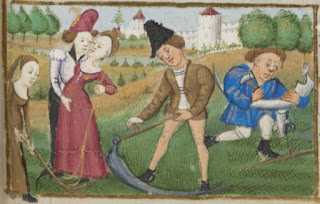
Christine de Pizan

Christine de Pizan
The Writer Christine de Pizan at Her Desk
Showing posts with label women and literature. Show all posts

Tuesday, March 19, 2024

Rokeya Sakhawat Hossain's "Ladyland"

Rokeya Sakhawat Hossain's "Ladyland"


Last fall, I read Michael Dirda's Washington Post review, "'Tis the Season for Horror and Weird Tales. Here Are Some Favorites." Now, I am not a reader of fantasy, science fiction, or horror, though my son is, and Christmas was coming. I not only read Dirda's review, but I bought some of the books he recommended for Christmas, including Joshua Glenn's collection of short stories, Voices from the Radium Age. I wrapped it up, put the book under the tree, and never thought about it again. Until a few days ago, when my son handed me the book and told me I needed to read the first story, Rokeya Sakhawat Hossain's “Sultana's Dream,” published in 1905.

I didn't know what to expect, or why my son wanted me to read it, but now I do! I've spent a lot of time reading, teaching, and writing about a recurring theme in writing by women: the dream of finding or creating a private and secluded retreat from the world of men. 

These imagined “women’s worlds” may be very small, a single room, for example, perhaps most famously Virginia Woolf's "a room of one's own." 

But many women writers are much more ambitious, fantasizing about cities (like Christine de Pizan's Book of the City of Ladies), even entire countries (like Charlotte Perkins Gilman's Herland), created for and inhabited exclusively by women.

I even wrote a book, Reading Women's Worlds from Christine de Pizan to Doris Lessing: A Guide to Six Centuries of Women Writers Imagining Rooms of Their Own.

And so my son's recommendation to me of Rokeya Sakhawat Hossain's short story, "Sultana's Dream," republished in Glenn's Voices from the Radium Age.

In the story, which appeared a decade before Gilman's Herland, Rokeya Sahkawat Hossain's narrator, Sultana, is resting on a chair in her bedroom while "thinking lazily of the condition of Indian womanhood." In her dream, she meets a woman whom she takes for her friend, Sister Sara. With "Sara," she walks out of her room and through a garden into the town around them--and it's at this point that she realizes the woman she is with is not her friend, but a stranger.

She is at first anxious--not only is she with someone she doesn't know, but as she tells the stranger, "as being a purdahnishin woman I am not accustomed to walking about unveiled." But she soon realizes that "there was not a single man visible."

Sultana finds herself in Ladyland, a place "free from sin and harm," a place where "Virtue herself reigns." And, notably, a place where men are "in their proper places": shut indoors, where they can be kept out of trouble.

What follows is a delightful overview of a world-turned-upside-down. Women know everything, do everything, create everything, and control everything. . . . And rather than getting and maintaining their position by force, women rule with their brains.

In reading a bit about Rokeya Sakhawat Hossain, I learned she wrote a novella with a similar theme, Padmarag: "Her novella Padmarag is similarly utopian in its depiction of a women-run school and welfare center, and is both feminist and anti-colonial in its outlook." (Quoted from the Penguin edition’s description of the work.)

Rokeya Sakhawat Hossain
(c. 1880-1932)
The novella's focus on the important of education for women and the creation of "a woman-run school and welfare center" puts me in mind of Mary Astell's A Serious Proposal to the Ladies . . . 

You can read "Sultana's Dream" online at Other Women's Voices (click here).

A Penguin edition that contains both "Sultana's Dream" and Pradmarog, edited by Barnita Bagchi and with an introduction by  Tanya Agathocleous, is also available (click here). 

An excellent introduction to Rokeya Sakhawat Hossain and her work is by Roushan Jahan, ed. and trans., "Sultana's Dream" and Selections from The Secluded Ones, accessible through the Internet Archive (click here).

For a website dedicated to Rokeya Sakhawat Hossain, you may want to check out the Hossain Memorial website--there you will find a biographical essay, bibliography, photo gallery, letters and speeches, along with a wealth of assorted material. 

And if you like science fiction and fantasy, don't forget Joshua Glenn's collection of short stories, Voices from the Radium Age!


Monday, July 25, 2022

Herrad of Landsberg, Abbess, Author, and Artist

Herrad of Landsberg, abbess of Hohenburg Abbey (died 25 July 1195)


The exact date of Herrad of Landsberg's birth is unknown, but most sources agree that she was probably born about the year 1130, making her about thirty years younger than Hildegard of Bingen, to whom she is sometimes compared. 

Although Herrad's place of birth was widely thought to be the castle of Landsberg, located in Alsace, France, more recent scholarship has called into question Herrad's association with the noble family associated with this castle. Today scholars prefer to identify her as Herrad of Hohenburg, though it is often hard to avoid the older name. (And I've used it here.)

A "self portrait,"
Herrad of Hohenburg,
detail from 
Hortus deliciarum
Little is known about Herrad's early life. There is no surviving evidence about her parents, where she might have been born, or when she may have entered the the Augustinian convent of Hohenburg, where she would spend her life and where she became abbess. 

While her former identification with the noble family of Landsberg castle is almost certainly incorrect, Herrad is likely to have had some aristocratic connection in order to have become abbess of such an institution.

The abbey of Hohenburg had been restored by the Holy Roman emperor Frederick Barbarossa, who placed it under the direction of the abbess Rilinda of Bergen. While Herrad would succeed her as abbess, probably about 1176, the exact date isn't known. And, as Joan Gibson notes, "Although Herrad acknowledges that she was instructed by Rilinda's 'admonitions and examples', it is not certain that Herrad was in fact a pupil of Rilinda, nor even necessarily educated at the abbey of Hohenburg."

Not is it clear when Herrad began compiling the encyclopedic work for which she is today remembered, the Hortus deliciarum or Garden of  Delights. The title, with its reference to a garden, clearly recalls Paradise, but it also refers to the nature of the work itself, as a florilegium, a collection of extracts. And here is the playful simile Herrad's uses in her preface, addressed to the nuns in her convent: 
I myself, the little bee, composed this book titled Garden of Delights, and drew from the sap of the diverse flowers of Holy Scripture and from philosophical works, inspired by God, and I constructed it by my love for you, in a manner a honeycomb full of honey for the honor and the glory of Jesus Christ and the Church.
A collection of 1,160 "textual extracts," Herrad's encyclopedia includes poetry, prose, and dialogue as well as song texts accompanied by musical notation, and some 340 illustrations in its 324 folios (648 pages). The sources from which Herrad draws for her encyclopedia include some classical authors (though not poets--her illustrations include Socrates, Plato, Aristotle, the Muses, and Odysseus), the philosopher Boethius, the writings of the Church Fathers, including St. Augustine, and more contemporary philosophers, among them, notably, Hildegard of Bingen.

The final illustration from
Hortus deliciarum,
Herrad address her sisters,
caption identifying her as
"Herrat hohenburgensis abbatissa"

As Thomas Head writes in his entry on Herrad in the Encyclopedia of Continental Women Writers, the collection "provided information on a wide range of biblical, theological, spiritual, and historical topics," though its specific purpose--and its intended audience--aren't altogether certain.

Again, it has been widely said that Herrad intended her encyclopedia for the education of the novices at the abbey, though more recent scholarship has questioned that assumption. The collection was certainly addressed to members of the community, as her preface indicates, but its specific audience and purpose have been debated. As Gibson notes, the encyclopedia contains material on marriage, so lay women may also have been "considered" as part of the audience for whom the the "garden" was intended. "Although there is a general agreement that the Hortus deliciarum is a remarkable and very important work of the late twelfth century," she writes, "it is nevertheless extremely difficult to classify."

However difficult it may be to classify, the encyclopedia itself was the product of Herrad's wide-ranging knowledge. Abbess Rilinda may have had some part in its origins, but Herrad is its singular inspiration, and she worked closely on all aspects of its production. 

As if to compound the many difficulties and uncertainties associated with the manuscript, the Hortus deliciarum no longer exists. Well, the original manuscript no longer exists. After the abbey of Hohenburg burned in 1546, the contents of its library went to the bishop of Strasbourg. The manuscript eventually wound up in the municipal library in the Central Registry of Strasbourg in 1803. It was destroyed in 1870, during Prussian bombardment of Strasbourg during the Franco-Prussian War.

What remains of Herrad's "garden of delights" are copies of the miniatures made in 1818 by Christian Moritz Engelhardt (head of the Strasbourg police!) and various (incomplete) copies of its texts, sketches, and tracings made before the book's destruction. (Evidently one man who copied parts of the manuscript took it to Paris and kept it for ten years!) Two scholars, A. Straub and G. Keller, produced a reconstruction of the Hortus deliciarium, beginning work in 1879 and publishing in 1899 (after Straub's death in 1891). It is from this late nineteenth-century "edition" that the illustration I have used here--Herrad addressing the nuns of her convent--is taken.

Herrad of Hohenburg died on 25 July 1195. 

For a discussion of the manuscript, you might start with the website of the Bibliothèque Alsatique du Crédit Mutuel (click here). It's particularly good on the history of the manuscript from the time it entered the municipal library in Strasbourg until its destruction. It also offers a gallery of illustrations that have been given some color.

A colorized version of
the final manuscript illustration,
Bibliothèque Alsatique

To view 12 black-and-white drawings made by Engelhardt in 1818, turned into copperplates, and now digitized, click here. You can see Engelhardt's drawing of the final manuscript illustration, Herrad and the convent's nuns, which was later reproduced by Straub and Keller in their reconstructed edition.

I've already linked you, above, to this nineteenth-century "facsimile." In 1979, the Warburg Institute produced a "partial facsimile" of the Hortus deliciarum with commentary by Rosalie Green, Michael Evans, Christine Bischoff, and Michael Curschmann. It is now considered the best available edition, but only 750 copies were produced. (As of this writing, two copies are available on Amazon--one for the low, low price of $2,160, the other $4,458.03--three cents???!!!)

I find Joan Gibson's "Herrad of Landsberg," to which I've already linked you, to be the best overall analysis. Her essay is in A History of Women Philosophers . . . , vol. 2, edited by Mary Ellen Waithe. (Which is also ridiculously expensive, so I've linked here to what's available via Google Books.)


Tuesday, March 1, 2022

Gwerful Mechain, Fifteenth-Century Author of "Playfully Erotic Poems"

 Gwerful Mechain, Welsh poet (c. 1462-1505)

A "playfully erotic" detail from a
fifteenth-century Book of Hours,
Bibliothèque de Genève, Ms. lat. 33

In his introduction to the poems of Gwerful Mechain, Donald Foster writes that she "is the only female poet of medieval Wales with a substantial body of work to have survived." 

Foster speculates that Mechain's work--perhaps as many as thirty-eight poems survive--may have been preserved "because the male scribes who controlled the transmission of Welsh poetry were amused by Gwerful's saucy and frank celebration of sexual intercourse." 

But Mechain's work also seems also to have survived because of her "respect" for the "complex Welsh poetic meters." She knows the tradition, but she can also play with it. And play with it she does.

While a substantial body of work exists, little biographical detail about Mechain's life is available. She was one of five children born to a Welsh nobleman, Hywel Fychan from Mechain, Powys. Her mother was a woman named Gwenhwyfar. She was married to a man named John ap Llewelyn Fychan, with whom she had a daughter, Mawd. And that's it.

Mechain may or may not have had a sexual relationship with the poet Dafydd LLwyd--the two exchange some frank verses, among them his poem in praise of a penis and her response, variously translated as "The Female Genitals," "Poem to the Vagina," or "Cunt," depending on the squeamishness of the translator.

In her Broadview edition of Mechain's poetry, Katie Gramich goes with "Poem to the Vagina.” There Gramich refers to her "blushes" when reading aloud the Welsh version of the poem, with its "extremely rude words." I prefer Donald Foster's approach--in translating the Welsh, he titles the poem "Cywydd [Welsh verse form] of the Bush," which seems to be the meaning of the title in its original, "Cywydd y Cedor," Instead of Gramich's use of the obscure "quim" in her English translation of the Welsh cedor, Foster goes for the gusto--in addition to the "bush" of the title, he uses "twat," "snatch," and "cunt." That's my kind of translation. 

Another detail from Bibliothèque de Genève,
Ms. lat. 33 (This manuscript has nothing
to do with Gwerful Mechain except for its few
--and randomly placed--explicitly 
sexual illustrations . . .
weird in a book of hours, but okay)

I also appreciate Foster's observation that, in this poem, Mechain writes back to the Petrarchan catalogue of the female beloved's beauties: she "lampoons the newly fashionable tradition of hyper-praising every female body part except the unmentionable one that the woebegone male lover has had in the back of his mind although not on the tip of his tongue." (For more on how a female writer responds to Petrarch's anatomization of the female body, click here and here.)

As vital and joyful as Mechain's "playfully erotic poems" are, she also addresses angry lines to her husband in "To Her Husband for Beating Her," a simple, frank curse that you will not forget: 

Through your heart’s lining let there be pressed, slanting down,
A dagger to the bone in your chest.
Your knee smashed, your hand crushed, may the rest
Be gutted by the sword you possessed.

(translated from the Middle Welsh by A.M. Juster)

In addition to Gramich's edition of Gwerful Mechain's poetry, you may enjoy Danièle Cybulskie's "Gwerful Mechain and the Joy of (Medieval) Sex" (here) and Lauren Cocking's "On the Gleefully Indecent Poems of a Medieval Welsh Feminist Poet" (here).

Click here for the Dictionary of Welsh Biography entry for Gwerful Mechain.

The phrase "playfully erotic poems," used in the title of my post, comes from Katie Gramich. 

I have posted on Mechain today, 1 March, because it is the saint's day of St. David, patron saint of Wales.


Wednesday, April 17, 2019

Marguerite St. Leon Barstow Loud: An "Imagination of No Common Order"

Marguerite St. Leon Barstow Loud, poet (born 17 April 1812)


In the preface to Wayside Flowers: A Collection of Poems by "Mrs. M. St. Leon Loud," editor Park Benjamin describes the volume's intended readers as those who "love tenderness and purity of thought, joined to simplicity and grace of expression." 

Marguerite St. Leon Barstow Loud,
frontispiece from Wayside Flowers, 1851
The poems are "like those 'wildlings of nature,' from which they borrow their title" (by the way, Benjamin has created the title). They are "the spontaneous productions of a fertile soil," "the free growth of an unartificial mind." They represent "nature's growth," not "exotics." And thus are better than "cultivated efforts."

Oh, dear. No work at all, then, right? The poems just happen????? Without intention, work, craft, effort?

In his last months of life, Edgar Allen Poe happily accepted the "relatively lucrative opportunity" to edit Wayside Flowers--he writes to a correspondent that he is on his way to Philadelphia to edit the work of the "poetess," whose wealthy husband had hired him. Poe writes, "[t]he whole labor will not occupy me 3 days." (Poe had been offered $100 by Marguerite Loud's husband--Poe had earned only $166 the entire year before.)*

Oh, dear. On the website of the Edgar Allen Poe Society of Baltimore, Marguerite St. Leon Barstow Loud is identified as a "minor American poet."

Aside from this rather disparaging information--and from Benjamin's preface in the volume of poetry, Wayside Flowers--not all that much is known about Marguerite St. Leon Barstow Loud. No Wikipedia entry, for example!!! (Update: As of 2022, an entry has been added!)

Marguerite St. Leon Barstow was born in Wysox, Pennsylvania, the daughter of Seth T. Barstow and his wife, Clarissa Woodruff. According to Benjamin, both parents were from New England, and Marguerite's father was a successful physician. 

In his preface to Wayside Flowers, Benjamin also indicates that Marguerite St. Leon's education was an informal one--her mother was her teacher, her parents both loved poetry, and the home had an "ample library

Her date of birth has been variously given. She died in Kenyon, Minnesota, and her gravestone indicates that she was born on 17 April 1812, but there are questions about this date, principally the fact that some sources indicate she was married in 1824--which would make her only twelve years old at the time of her marriage. Thus other dates for her birth are suggested--even a date of "ca. 17 April 1800" (see the University of Virginia's Collective Biographies of Women database)!

But the preface to her volume of poetry specifically addresses the date of her marriage as well as explaining the source of the confusion--Marguerite St. Leon Barstow was married in 1834, not 1824, an erroneous date that appeared in Caroline May's 1848 The American Female Poets.**

Title page of the 1851 Wayside Flowers
So there's no need for anyone to twist themselves into pretzels or question the date of birth on her headstone. Marguerite Barstow was born in 1812, and she married in 1834. Her husband, John Loud, was a successful piano manufacturer in Philadelphia. The couple had three daughters: Caroline, was born in 1834, Clara in 1837, and Darwina in 1842. 

Edgar Allen Poe died before he could travel to Philadelphia to edit Wayside Flowers. The book was finally published in 1851, and it did not sell well. Of the 550 copies that were printed, 360 copies were returned, unsold, to the Louds.

In his discussion of Poe's intention to edit Wayside Flowers and Poe's death, Matthew Pearl notes that "according to electronic library database Oasis, only fourteen original copies of the book are held by American libraries."

Which may account for the fact that Loud's elegy, "The Stranger's Doom," one of the earliest poems that seems to be about Poe's death, has "attracted little critical attention."

But, thankfully, you don't have to search out one of the few print copies of Marguerite St. Leon Barstow Loud's Wayside Flowers. It is now readily available online (this link takes you to a copy made available by the HathiTrust Digital Library).

Poe himself seemed to think well of Marguerite Loud as a poet. Of her he wrote in 1841:
Mrs. M. ST. LEON LOUD is one of the finest poets of this country; possessing, we think, more of the true divine afflatus than any of her female contemporaries. She has, in especial, imagination of no common order, and unlike many of her sex whom we could mention, is not content to dwell in decencies forever. 
While she can, upon occasion, compose the ordinary metrical sing-song with all the decorous proprieties in which are in fashion, she yet ventures very frequently into a more ethereal region. We refer our readers to, a truly beautiful little poem entitled the “Dream of the Lonely Isle,” lately published in this Magazine. 
Mrs. Loud’s MS. is exceedingly clear, neat and forcible, with just sufficient effeminacy and no more.
Marguerite St. Leon Barstow Loud died on 4 November 1889. She was seventy-seven years old. 

Detail from headstone of
Marguerite St. Leon Barstow Loud
(photo by Dave Vangsness,
posted at Find a Grave)

*The link here is to a .pdf version of Matthew Pearl's "A Poe Death Dossier: Discoveries and Queries in the Death of Edgar Allen Poe"--using the search function, you will locate all the references to Marguerite St. Leon Barstow Loud.

**The link here is to the edition of 1854, which reprints the 1824 date in its biographical note for "Marguerite St. Leon Loud."

Update, 22 April 2022: I am deeply grateful for a wealth of material sent to me by a descendant of Marguerite St. Leon Barstow, her third great granddaughter. 

The detail Marguerite's descendant provides has allowed me to correct the name of Marguerite's youngest daughter, Darwina. One of the sources I consulted when writing my original post had given the name as "Davina," and I hadn't noticed it correctly spelled elsewhere. 

Darwina, as it turns out, is a family name. On the origin of this name, Marguerite's third great granddaughter writes that Seth Barstow, Marguerite's father, had named his first son (b. 1809) after the English physician and philosopher Erasmus Darwin. But this boy died when he was very young, just a week after the birth of Marguerite St. Leon in 1812, and so Seth Barstow named his next-born child, a daughter, "Darwina" (b. 1815). In 1841, Marguerite St. Leon named her youngest daughter Darwina. (One of Marguerite's brothers, in turn, named two of his daughters after his sisters, a younger Marguerite St. Leon, born in 1837, and a younger Darwina, born in 1843.)

Marguerite's own "seemingly exotic name" is also explained by her descendant, who writes that "Marguerite St. Leon" was a character in philosopher William Godwin's 1799 novel, St. Leon: A Tale of the Sixteenth Century. (Godwin was the husband of Mary Wollstonecraft and the father of Mary Shelley.)

Darwina Francis Loud, Marguerite's daughter, is herself a writer, though not a poet (or at least not a published poet). In the midst of the Civil War, she headed south in 1864, engaged in the work of educating black soldiers, recognizing that, in this endeavor, she is "a pioneer." In the summer of 1865, when she was twenty-four years old, Darwina Loud was sent to what she describes as "the lonely camp of a regiment of black soldiers" in the "swamps and woods of Mississipipi." Upon her arrival at Midway Station in August 1865, she decides "to commence a little journal of daily events as they transpire." She continues to record her experiences through September, her "last night in Midway," when she is filled with uncertainty. 

"These ten feet of canvas walls shut in all the home I can call mine in all this beautiful great world, so full of happy homes and loving, generous hearts," she writes. "I wonder why I can't creep into some of them and find rest & shelter." The future is unclear: 
I went down to the branch school house this evening to take a farewell look at the spot where some few pleasant hours were spent. As I looked up into the green glimmering depths of the great oak, I thought of the future--where and how is it all to end?--What has the coming year in store for me?
Despite her feelings of despair (". . . I want something. I don't know what--I think it must be Christ I want. Oh, when shall I find him?"), Darwina closes out her diary with a long narrative "gleaned from the experience of one who for a year shared the interests and the adventures of the 52nd U.S. Colored Infantry." It is something of a summary of the history of the founding of the country, reflecting on the roles of both Christopher Columbus and George Washington--it is a history that requires "a close discrimination . . . between the glowing fancies of traditions and the matter of fact realities of truth."

Whatever doubts this remarkable young woman felt as she faced the future in September 1865, her life soon changed once again, and she found the home she had thought she might not find. Not long after she packed up her tent in Mississippi, on 22 October 1865, she married Edward Henry Burton in Illinois. Genealogical data posted on FamilySearch shows that the couple had at least seven children (including a daughter, named after Darwina's mother, Marguerite St. Leon). Darwina Loud Burton died in Hallett, Oklahoma, on 21 January 1897.

I have been given the very great gift of a typescript of Darwina F. Loud Barstow's diary sent to me by her third great granddaughter, but an edition by Margie Bearss and Rebecca Drake, published as Darwina's Diary: A View of Champion Hill--1865, is available. You can order it directly (click here), or you can find a used copy from Amazon (click here). 

Sunday, July 15, 2018

Qiu Jin, the "Woman Knight of Mirror Lake"

 秋瑾, Qiu Jian, Revolutionary, Feminist, Writer (executed 15 July 1907)


The Chinese revolutionary and writer Qui Jian was born on 8 November 1875 in Fujian Province to a respected but downardly mobile family during the Qing Dynasty period.*

Qiu Jian, in an undated photograph
Her father, Qiu Shounan, was a government official, her mother, surnamed Shan, from a distinguished family of writers and government officials.

Qiu Jian's parents supported her academic interests by providing her with an education, though she also dreamed of becoming a heroic female figure, like the legendary warrior woman, Hua Mulan. To that end, she studied sword fighting, martial arts, and riding in addition to history, poetry, and music.

Despite their willingness to educate their daughter, her parents expected her to conform to the expected roles for women--her feet were bound,** she had to study needlework, and, at age nineteen, she was married to a wealthy merchant, Wang Ting-jun, a husband of her parents' choosing. She gave birth to a son and a daughter, but the marriage was unhappy.

In 1903, her husband gained an official position at the imperial court, and the couple moved to Beijing. where her husband seems to have devoted a great deal of his time to drinking, gambling, and enjoying himself in brothels. 

While her husband was thus occupied, Qiu Jian found the companionship of other women with similar reformist ideas and ambitions and began writing poetry. She also witnessed the backlash against the Boxer Rebellion--the Yihequan (義和拳), or Fists of Harmony and Justice, the "Boxers," in English--an anti-foreign, anti-colonial, anti-Christian uprising that aimed at expelling Westerners from China.

In 1903 or 1904 (accounts vary), Qiu Jian left her husband and children and went to Tokyo, where she studied at a school for Chinese students. According to one account of her life, "she changed her name from Qiu Guijin to Qiu Jin (removing the character 'gui,' which means 'boudoir,' a daughter’s or woman’s inner space), and enrolled in Shimodo Utako’s Women’s Practical School."

In Tokyo she also connected with other Chinese students who were interested in revolutionary change in China. She organized students, spoke and wrote on feminism and revolution, and joined revolutionary societies like Guangfuhui (Restoration Society), led by Cai Yuanpei and Tongmenghui (Revolutionary Alliance), led by Sun Yat-sen.
Qiu Jian in Tokyo

It was in Tokyo that she seems to have unbound her feet, and she also decided to dress like a man. She began publication of  Baihua Bao (Vernacular Journal), where she wrote about ending Chinese feudalism, the need for gender equality, and against the practices of forced marriages and foot-binding.  

In 1906, Qiu Jin returned to China, focused on bringing down the Qing dynasty. She began publication of the radical feminist journal, Zhongguo Nu Bao (Chinese Women), linking feminism and revolution: “The young intellectuals are all chanting, ‘Revolution, Revolution,’ but I say the revolution will have to start in our homes, by achieving equal rights for women."

In 1907, she took up a position as head of the Shaoxing Datong Sports Teachers School, which, although it seemed to be a school training physical education and sports teachers, actually trained military leaders for the revolution.

Along with her cousin, Hsu His-lin,  she began working with revolutionary groups to organize and train revolutionaries. But on 6 July 1907, Hsu was arrested and tortured by Qing authorities; he was executed the next day.

Despite warnings that authorities were searching for the woman who was believed to be Hsu's co-conspirator, Qiu Jin did not flee. On 12 July, she was arrested and tortured, though she refused to admit her role, her own writings proved her guilt.

She was beheaded on 13 July 1907. She is often remembered for her final line of poetry: "秋風秋雨愁殺人, Autumn wind, autumn rain, they make one die of sorrow.” (Her surname, "qiu," means "autumn.")

Six months after her execution, friends buried her beside West Lake in Hangzhou.  

Statue of Qiu Jian in Hangzhou
Four years after her death, the Chinese Revolution began, and by 1912, the Qing dynasty was overthrown.

Here's a poem that knocks me out, "Capping Rhymes with Sir Shih Ching from Sun's Root Land" (trans. Zachary Jean Chartkoff):
Don't tell me women are not the stuff of heroes,
I alone rode over the East Sea's winds for ten thousand leagues.
My poetic thoughts ever expand, like a sail between ocean and heaven.
I dreamed of your three islands, all gems, all dazzling with moonlight.
I grieve to think of the bronze camels, guardians of China, lost in thorns.
Ashamed, I have done nothing; not one victory to my name.
I simply make my war horse sweat. Grieving over my native land
hurts my heart. So tell me; how can I spend these days here?
A guest enjoying your spring winds? 
漫云女子不英雄,
萬里乘風獨向東。
詩思一帆海空闊,
夢魂三島月玲瓏。
銅駝已陷悲回首,
汗馬終慚未有功。
如許傷心家國恨,
那堪客裡度春風。

For a great place to start, see Amy Qin's "obituary" of Qiu Jin in the New York Times, published as part of the series "Overlooked."


*There are many transliterations of Chinese names in English, and I have followed those in my sources. I add apologies here for any inconsistencies or errors.  

**Several online sources indicate that Qiu Jian's feet were bound when she was a very small child, five or six years old, and that she "unbound" them herself, when she was a grown woman, in 1903 or 1905 (for one example, click here). Yet others indicate that her "indulgent parents" may not have bound her feet tightly, since she seem to have been able to continue to continue her martial training. Online images of an adult Qiu Jian do show her feet.

Whatever she experienced personally, Qiu Jian's objections to foot-binding are evident from her own writing:
We women, who have had our feet bound from early childhood, have suffered untold pain and misery, for which our parents showed no pity. Under this treatment our faces grew pinched and thin, and our muscles and bones were cramped and distorted. The consequence is that our bodies are weak and incapable of vigorous activity, and in everything we do we are obliged to lean on others. . . . Sisters, let us today investigate the causes which have led to this want of spirit and energy among women. May it not be because we insist on binding up our girls’ feet at an early age, speaking of their “three-inch golden lilies” and their “captivating little steps”?  

Friday, January 19, 2018

Dorothea and Gladys Cromwell: The Horrors of War

Dorothea and Gladys Cromwell, World War I nurses (died 19 January 1919)


Twins Dorothea and Gladys Cromwell were born in Brooklyn, New York, on 28 November 1886, the daughters of a wealthy businessman, Frederic Cromwell, and his wife, Esther Whitmore Husted. (Frederic had interests in railroad and gas companies "among other corporations"--he also was a trustee and then treasurer for Mutual Life Insurance of New York--while Esther was herself the daughter of a "well-known businessman and street railroad president of Brooklyn.")

Thus born into wealth and privilege, the twin girls were educated at Brearley School, a private school founded by Samuyel A. Brearley and designed to "provide young women with an education comparable to that available to their brothers."

The sisters inherited a fortune after their father's death in 1887, purchasing an apartment in New York on Park Avenue. Gladys also began publishing poetry, despite the objections of her family, who thought that publication violated the family's privacy. Her poems appeared in Poetry magazine (1917, 1918), and she published a collection, The Gates of Utterance and Other Poems, in 1915.

In January 1918, Dorothea and Glady joined the Canteen Service of the Red Cross, sailing for France and the battlefields of the Great War. They were stationed at Chalon-sur-Marne and Verdun, serving in the canteen but also, apparently, as nurses.
American Red Cross canteen workers, 1918
(Gladys Cromwell, second from left; Dorothea, far right)

About their service in France, biographer Anne Dunne wrote:
For eight months they worked under fire on long day and night shifts; their free time was filled with volunteer outside service; they slept in “caves” or under trees in a field; they suffered from the exhaustion that is so acute to those who have never known physical labor; yet no one suspected until the end came that for many months they have believed their work a failure, and their efforts futile.
The inhabitants of Chalons reportedly regarded them as "the saints" and "twin angels," while those who worked with them "loved and admired" the sisters for their bravery and their "tireless and efficient labor." In October, the two requested a transfer to an evacuation hospital, where they would be able to work with American soldiers. Dunne notes that the two had already begun to exhibit "signs of mental breakdown," worn out by their work and shocked by the "horrors" of the conditions of the front.

Nevertheless, they decided to remain in France after the Armistice on 11 November 1918, and they returned to Chalons. But, urged by their brother, Seymour, to return home, they ultimately agreed to back to the United States, sailing on the SS La Lorraine on 19 January 1919, leaving from Bordeaux.

New York Times story,
reporting deaths of
Cromwell sisters,
25 January 1919
That same night, according to later witnesses, the two went out onto the "windy, cold decks"  and briefly joined hands. They separated, and each climbed on the railing and then slipped off the boat and into the water. 

Although the ship turned around, and those on board searched for the Cromwell sisters, their bodies were not recovered until 20 March. Their brother, Seymour, refused at first to believe that his sisters had committed suicide--he believed that they had had missed the Lorraine and were traveling on another ship--but the Lorraine's captain reported that the two were not on board and that their luggage was in their room, as were suicide notes addressed to their Red Cross supervisor, their brother, their sister-in-law, and a friend. The letters confirmed their shared intention to end their lives.

Dorothea and Glady were buried in the Surennes American Cemetery in France, with the two being awarded the Croix de Guerre on 22 March 1919--the medal was an honor awarded to those who had performed heroic acts during a time of war.

The next year, on 13 March, the sisters were honored with the Médaille de la Reconnaissance française, the Medal of French Gratitude. It was awarded with «gratitude portée à toutes les initiatives individuelles ou collectives, qui se sont manifestées en France, chez les Alliés et dans le monde entier, pour venir en aide aux blessés, aux malades, aux familles de militaires tués au combat, aux mutilés, aux invalides, aux aveugles, aux orphelins et aux populations chassées et ruinées par l’invasion» ("gratitude for all the individual or collective initiatives, for those who have come forward in France, both with the Allies and throughout the world, to come to the aid of the wounded, the sick, the families of soldiers killed in combat, the disabled, the blind, the orphans and the populations driven out and ruined by the invasion").

A second book by Gladys Cromwell, Poems, was published posthumously. Dunne's biographical essay is at the end of this collection.

I first came across a reference to the Cromwell sisters in Vivien Newman's We Also Served: The Forgotten Women of the First World War, a good introduction to the numbers of ways women participated in the war.

In order to commemorate the one-hundredth year anniversary of the First World War, Brooklyn's Green-Wood Cemetery (now a National Historical Landmark) began the publication of biographies those who fought in WWI and who were interred at the cemetery. Although Gladys and Dorothea are not buried there, biographies of both women are included, and a cenotaph erected in their family's lot now commemorates their lives and deaths. To read their entries in the "Biographies of World War I Veterans," click here. An essay by Jeff Richman, "A Twin Tragedy," is also posted at the Green-Wood site (available by clicking here).

If you have access to the New York Times archives, the disappearance and deaths of the Cromwell sisters is widely reported there, useful primary-source accounts of the tragedy. The 1919 Expository Times, while reviewing Gladys Cromwell's posthumous publication, also includes biographical information. 

Sunday, October 8, 2017

Lady Margaret Douglas, Poet and "Progenitor of Princes"

Margaret Douglas, countess of Lennox (christened 8 October 1515)


Margaret Douglas was the daughter of Margaret Tudor, Henry VIII's older sister--the Tudor princess's first marriage had been to James IV of Scotland. After the king's death, the queen dowager had married Archibald Douglas, the earl of Angus. Margaret Douglas was the only child of Margaret Tudor's second marriage.

Margaret Douglas,
c. 1560-65
As a widowed queen, Margaret Tudor struggled to maintain her role as regent for her young son, who at seventeen months old succeeded his father as James V of Scotland in 1513, after the king's death at the battle of Flodden.

But when the queen dowager married her second husband secretly in 1514, she lost her regency and her guardianship of her two royal sons, the child-king, and his younger brother, Alexander, born in 1514, after his father's death.

In 1515, heavily pregnant with Angus's child and deeply embroiled in the violent political struggles of the Scottish lords, the former queen left the country, undertaking a desperate escape to England.

She took refuge in Harbottle Castle (Northumberland), where her daughter, Margaret Douglas, was born on 8 October 1515. The elder Margaret, too ill after childbirth to travel south to join her brother's court, remained in the castle with her daughter until she recovered enough to make the journey.

In late April of 1516, mother and daughter were finally able to move on to the safety of Henry's court, where they were greeted by Henry's queen, Katherine of Aragon, who had just given birth to a daughter of her own, Mary Tudor, in February. 

But after a year in England, with her husband Angus refusing to join his wife and daughter, Margaret Tudor returned to Scotland and her husband, taking Margaret Douglas with her. The turbulent marriage of Margaret and Angus, despite their brief reconciliation, was not to last.

Back in Scotland, Margaret was allowed to have some contact with her son, James V, but her difficult marriage disintegrated, and by the time the younger Margaret was three, her parents were engaged in a long and bitter struggle. 

Though the two would continue in their attempts at reconciliation, primarily at the urging of Henry VIII, by 1527 the marriage was irretrievably broken, and it was at last annulled by Clement VII--while declaring Margaret Tudor's second marriage invalid, the pope nevertheless declared Margaret Douglas legitimate. (Margaret Tudor would go on to marry a third time, to Henry Stewart, first lord Methven--but that's another story.)

At some point between 1525 and 1528, Angus removed his daughter from her mother's guardianship--although some historians have referred to this as a kidnapping or even an abduction, Angus had every legal right to take possession of his child. Now in her father's custody, Margaret, began to identify not as English but Scottish.

Angus continued to involve himself in the struggle to control the Scottish throne and the person of the young king. By 1528, Angus was not only back in Scotland but once again regent--though he quickly lost power. By the end of the year, the young king escaped from Angus's control and joined his mother. 

Attainted and finding his lands confiscated, Angus managed a truce and fled to England, taking his daughter with him, recognizing her value as a significant political pawn. While Margaret Tudor's son, James V, might be considered an heir to the English king, he was at least technically debarred by reason of his Scottish birth. Margaret's daughter, on the other hand, faced no such bar. She was English--born in Northumberland. 

But once in England, Margaret Douglas was removed from her father's custody and joined the household of her godfather, Cardinal Thomas Wolsey, her residence established in Berwick Castle. She remained there until the spring of 1530; after Wolsey's death, she was summoned to her uncle's court.

Her proximity to the throne would shape her turbulent life. In 1530, she was made a lady-in-waiting to her cousin, Mary, whose residence was at the royal palace at Beaulieu. The two would remain lifelong confidantes. 

But in 1533, with the English king's marriage to Anne Boleyn, Margaret Douglas was transferred to the new queen's court, once again appointed as lady-in-waiting. After Elizabeth Tudor's birth, Margaret was a lady of honor to the princess. 

While at the court of Henry and Anne, she met and fell in love with Lord Thomas Howard, the queen's uncle. The two seem to have entered into a contract for marriage. When King Henry discovered the relationship between the two, he regarded it as a dangerous attempt by Howard to gain control of the throne. On 8 June 1534, Henry had the pair arrested and imprisoned in the Tower of London.

Howard was attainted for treason, his position becoming increasingly dire after Anne Boleyn's fall and execution in 1536, but he was not tried and executed--he eventually fell ill as a result of the harsh conditions he suffered while imprisoned in the Tower.

For her part, Margaret also fell ill, but she was transferred from the Tower into the custody of the abbess of Syon Abbey.  She was finally released on 29 October 1537, but she would not be reunited with her lover--he died in the Tower just two days later.

The poems that Howard and Margaret Douglas exchanged during their calamitous affair are now part of the collection known as the Devonshire Manuscript--an anthology of courtly lyric poetry composed and compiled by members of the royal court, many of them women. In addition to its significance as a repository of sixteenth-century poetry, the manuscript collection "also provides a unique insight into the precarious position of Renaissance women in, or close to, power."

A leaf from the Devonshire Manuscript
As a result of his niece's actions, the king altered the Act of Succession to make any attempt to "espouse, marry or deflower being unmarried" a female claimant to the throne an act of treason.

Margaret Douglas was released from her confinement in Syon in order to attend the funeral of Jane Seymour, Henry's third queen. Fearing that his long-desired son's legitimacy might be questioned by the Catholic church, given his complicated marital history, Henry VIII had his niece Margaret declared illegitimate--on he grounds that her mother's marriage to Angus had been entered into clandestinely, 

Although legally debarred from the throne, Margaret was welcomed back to court. In 1539, she was appointed as a member of the household of Anne of Cleves, serving as one of the English women who would greet the future queen on her arrival in England. The Cleves married was annulled in 1540.

By that time, Margaret had involved herself in yet another disastrous romantic entanglement, this time with Sir Charles Howard, the brother of Henry's fifth queen, Catherine Howard. (Charles Howard was also the nephew of Margaret's earlier love, Thomas Howard.)

Margaret once again found herself in disgrace, though on this occasion she avoided the Tower and went immediately back to Syon. (For his part, Charles Howard escaped to the continent.) But she was quickly released after Catherine Howard's fall and execution, once more back at court and appointed to the household of Henry's last queen, Katherine Parr.

In 1544, Margaret Douglas at last found a marital prospect of whom the English king approved, and she married the Scottish exile Matthew Stewart, earl of Lennox. Although they remained in England, the couple had many interests (and intrigues) in Scotland. (Still fearful of Margaret's claims to the English throne, Henry VIII excluded her from the succession in his will.)

Now the countess of Lennox, Margaret Douglas quickly gave birth to eight children, but only two survived, two sons, Henry Stuart, lord Darnley, in 1545, and Charles Stuart, earl of Lennox, in 1555. Meanwhile, during the brief reign of Edward VI, the staunchly Catholic Margaret and her more religiously opportunistic husband largely stayed away from court.

By contrast, she remained at the English court throughout the reign of Queen Mary (1553-58). The first English queen reportedly told Simon Renard, Habsburg ambassador to the English court, that her cousin was "best suited" to succeed her on the English throne.

But after Mary's death, Margaret retired to Yorkshire. Her northern household was a center for Catholic intrigue and numerous political plots. 

Margaret involved herself in many of them--notably angling for the marriage of her son, Darnley, to the widowed Mary Stuart, queen of Scotland. In the midst of her scheming, she was again arrested and imprisoned--unlike her husband, who was sent to the Tower, Margaret was moved south but placed under house arrest at Sheen (the former Carthusian monastery, not far from the palace of Westminster).

The two were held for a year, but by 1563, Margaret Douglas was accepted back at court, perhaps because she could be kept under Elizabeth's watchful eye. But after Darnley's marriage to the Scottish queen, Margaret Douglas found herself once more in the Tower, where she remained until Darnley's murder in 1567.  

Released by Elizabeth, Margaret Douglas witnessed the fulfillment of many of her aspirations when she saw her grandson, Darnley's child, become James VI after his mother, Mary Stuart, was forced to abdicate on 24 June 1567. Margaret's husband, the earl of Lennox, was at last able to return to Scotland, serving as regent for his grandson--at least until his murder on 4 September 1571.

Still the indomitable countess was not to be stopped. With the redoubtable Bess of Hardwick, she conspired to marry her second son, Charles, to Bess's daughter, Elizabeth--this couple would give birth to the unfortunate Arbella Stuart. (As noted at the British Library website, "Douglas's disastrous love affair [with Thomas Howard] in turn foreshadowed her granddaughter Arbella Stuart’s experiences almost 75 years later.") In 1574, after the marriage was accomplished, a furious Queen Elizabeth ordered Margaret to the Tower once more.

Having achieved this last marriage, Margaret Douglas "retired" from her political intrigues and matchmaking, dying just a few years later on 9 March 1578. Although she died in poverty, she was given an extravagant tomb in Westminster Abbey, funded by her cousin and adversary, Queen Elizabeth.

The tomb of Margaret Douglas, countess of Lennox,
Westminster Abbey
Margaret Douglas did not live to witness her ultimate dynastic triumph, when her grandson James VI of Scotland would ascend to the English throne in 1603, after the death of Elizabeth, becoming James I of England. 

For an excellent essay, I recommend "King Henry's Niece," by Leanda De Lisle. (In her essay she calls Margaret the "progenitor of princes," which I have quoted in the title of this post.)


Friday, September 29, 2017

Mrs. Gaskell and Mothers of the Novel

Elizabeth Cleghorn Gaskell (born 29 September 1810)


Among nineteenth-century women novelists (aside from the Brontë sisters, of course) Elizabeth Gaskell may be one of the best known to modern readers, if for no other reason than several of her works of fiction have been made into television series--in 1999, the BBC aired a four-part adaptation of Wives and Daughters; in 2004, the BBC produced a four-episode mini-series of North and South; and a 2007-2008 BBC adaptation of Cranford, starring Judi Dench and Eileen Atkins, earned BAFTA, Emmy, and Golden Globe awards. All three productions aired in the US on PBS.

Born on 20 September 1810 in Chelsea, Elizabeth Cleghorn Stevenson was the daughter of William Stevenson, a Unitarian minister, treasury official, and journalist, and Elizabeth Holland, whose family also had strong Unitarian connections.

Elizabeth was the youngest of their eight children (only two of whom would survive infancy). Her mother died in 1811, just months after giving birth to Elizabeth, who at thirteen months old was sent to live with her mother's sister, Hannah Lumb, whom Elizabeth would later describe as "more than a mother."

The young Elizabeth Stevenson,
miniature portrait by
William John Thompson
William Stevenson remarried, raising a second family with his second wife, Catherine Thompson, while Elizabeth remained with her maternal family in Cheshire throughout most of her childhood. The Cheshire market town of Knutsford, where Elizabeth lived with her aunt, was transformed by fiction into the town of Cranford.

(Catherine Thompson Stevenson's brother, the miniaturist William John Thompson, would later paint the portrait of Elizabeth as a young woman I've included on this entry.)

In 1832, Elizabeth Stevenson married William Gaskell, a Unitarian minister associated with the Cross Street Unitarian Chapel in Manchester.

As the Gaskell Society describes it, Manchester in the early nineteenth century "was a great cultural and intellectual centre, boasting institutions like the Literary and Philosophical Society, the Mechanics Institute and the Athenaeum. It was at the forefront of the new industrial age, but this rapid growth, as well as generating much wealth, also led to uncontrolled urban development and appalling squalor."

In her new life in the city, Elizabeth Gaskell worked with her husband to offer aid and support for the poor and to teach reading and writing, in addition to Scripture, in the Unitarian Sunday school. She observed the radical politics and social tensions of the city--as she would write in the preface to her first novel, Mary Barton (1848), "I had always felt a deep sympathy with the care-worn men, who looked as if doomed to struggle through their lives in strange alternations between work and want."

During the first years of her marriage, Gaskell gave birth to three daughters (1834, 1837, 1842), and she began writing, publishing several stories. But after the death of her son, who died of scarlet fever in 1845, just nine months old, Gaskell began writing a novel, at her husband's suggestion, as a way of distracting herself from her profound grief. 

That novel, Mary Barton, depicted the dire circumstances of industrial workers in the city of Manchester, profoundly affecting the public conscience. It also brought Gaskell to the attention of Charles Dickens, who included her work in his publications and helped her to become one of the most popular authors of her day.

Gaskell did not avoid controversy. Her novel Ruth, published in 1855, tells the story of a young seamstress who works in a sweatshop; seduced and betrayed by her lover, she attempts suicide and gives birth to an illegitimate child. Although the "fallen" woman ultimately redeems herself, she is never allowed to be happy or fully reintegrated into society--though after her death she is praised by those who knew her.

North and South (1855) is an example of what is now called a "social novel," focusing on the tensions between employers and workers from the perspective of a young woman who moves from her home in the rural south of England to live in the industrial town of Milton, a fictionalized Manchester.

Sylvia's Lovers (1863) is set during the Napoleonic period, and unlike her more well-known work, is a story of obsessive love, enforced military service (the notorious press gangs), dutiful marriage, and the eventual realization that an unloved husband is loved after all.

Gaskell's last novel, Wives and Daughters, was published in serial installments from August 1864 to January 1865, but Gaskell died before she completed the coming-of-age story of Molly Gibson, whose father remarries, bringing into the young girl's life a pretty but dangerous stepsister, Cynthia Kirkpatrick.

Gaskell was also a friend of the novelist Charlotte Brontë, whom she met in 1850, and she wrote the first biography of Charlotte, who died in 1855, based on their shared correspondence. The biography was published in 1857, and it provoked controversy--in her work, Gaskell suppressed some aspects of her friend's passion for the married Constantin Heger, while emphasizing the dissolute nature of Charlotte's brother Branwell and overemphasizing the Brontë sisters' isolation. Gaskell faced the prospect of lawsuits for her depictions of many Brontë friends and acquaintances who objected to Gaskell's depiction of them in the biography. 

Elizabeth Gaskell,
a photograph from c. 1860
Gaskell died suddenly of a heart attack on 12 November 1865 in Hampshire, where she was buying a home that was to be for her retirement. She was just fifty-five years old. Her last novel, North and South, was unfinished.

The Gaskell Society’s website, which I’ve linked to above, offers extraordinary resources. If you have access to this resource, an excellent account of Gaskell's life and work is Jenny Linglow's entry in the Dictionary of National Biography (click here). 

If you enjoy podcasts, you will want to listen to this episode of In Our Time, "Elizabeth Gaskell's North and South" (click here).