Christine de Pizan

Christine de Pizan
The Writer Christine de Pizan at Her Desk
Showing posts with label women and the law. Show all posts

Thursday, April 25, 2024

Cecilia de Ridgeway and Her "Extraordinary Abstinence"

Cecilia de Ridgeway (pardon signed 25 April 1357)

Sometimes there is a tiny crack in the historical narrative that allows us to glimpse beyond the stories that are the usual stuff of history. Such is the case of Cecilia de Ridgeway, a fourteenth-century Englishwoman who was imprisoned in Nottingham Castle. Except for a very few details. we know nothing about her--but those few details are tantalizing. 

I first came across the name of Cecilia de Ridgeway in Ian Mortimer's Edward III: The Perfect King. What could be more representative of the traditional view of  "history" than a biography of one of history's "great men"? A king, wars, power, political scheming, political allies, political rivals, law, economics . . . 

Mortimer's biography of Edward III encompasses 402 pages (that's just the text--including notes, appendices, bibliography, charts, and index, the book has 536 pages).

A nineteenth-century "reconstruction" of
Nottingham Castle--like Cecilia de Ridgeway's
life, the medieval castle has been lost

Of these 402 (or 536) pages, only 6 lines on page 328 refer to Cecilia de Ridgeway, just 3 sentences. Three sentences to relay a person's life. 

A second reference--only a phrase--appears on p. 341. In this case, the king's pardon of Cecilia Ridgeway is included among the Edward's "significant religious acts."

As Mortimer's reference to her demonstrates, what remains of Cecilia de Ridgeway's life can be summarized in a few short sentences.

In 1357, Cecilia de Ridgeway was accused of having killed her husband, John. When she was indicted for his murder, she refused to plead. 

She was imprisoned in Nottingham Castle until such time as she would make her plea, subject while imprisoned to peine forte et dure--that is, a person accused of a crime could be imprisoned and punished until such time as the defendant would plead. In most cases, this involved starving the person into submission. (In the fifteenth century, a defendant who refused to plead could be subjected to the punishment of pressing--this is what happened to Margaret Clitherow, who was pressed to death.)

Cecilia de Ridgeway is supposed to have been deprived of food and drink for forty days. But Cecilia neither died nor pleaded--her case was reported to Edward III. 

Regarding her survival under such circumstances as "against human nature" and thus a miracle, the king pardoned Cecilia: "We, for that reason, moved by piety, to the praise of God and the glorious Virgin Mary his Mother, whence the said Miracle proceeded, as it is believed, by our special grace, pardoned the execution of the aforesaid Cecilia" (Nos, ea de causa, pietate moti, ad laudem Dei & glori[osae] Virginis Mariae Matris suae, unde dictum Miraculum proc[essit], uc creditur, de gratia nostra speciali, pardonavimus eidem Ceciliae Executionem Judicii praedicti.)

Further, the king issued his pardon "desiring that the same Cecilia should be freed from prison, and that her body should not be attacked any further, on the occasion of the above-mentioned judgment" (Volentes quod eadem Cecilia a prisona praedicta deliberetur & de Corpore suo ulterius non sit impetita, occasione judicii supradidite).

Edward III's judgment was made at Westminster on 25 April 1357. 

For the pardon, click here.

Sir Walter Scott somehow came across the case of Cecilia de Ridgeway, including it in his 1809 Collection of Scarce and Valuable Tracts, on the Most Interesting and Entertaining Subjects: But Chiefly Such as Relate to the History and Constitution of These Kingdoms . . .  (click here).

A brief headnote about Cecilia de Ridgeway and a transcription of the pardon are included in a 12-page collection of  cases of "extraordinary abstinence" (click here).

A rather gruesome account of Cecilia de Ridgeway's crime, which seems to have been embellished by details the source of which are unknown, was published in J. G. N. Clift's article on fasting in The Journal of the British Archaeological Association in 1909 (click here). According to Clift, Cecilia poisoned her husband "secretly and with malice aforethought," giving him "a certain loathsome, noxious drug." There are no citations--I'd love to know where the details come from. I also quite like Clift's suggestion that Cecilia de Ridgeway's jailer might have been able to "throw some light" on how she managed to survive forty days without food or water . . . 

There are a few other references, aside from these, but they all rely on the pardon as their source or on the account by Scott, who is also relying on the pardon.

If this brief detail about Cecilia de Ridgeway isn't the stuff of historical fiction, I don't know what is . . . Who was her husband? Did she actually murder him? If so, how? If not, how was it that she was accused? How did her story make its way to the king? What happened to her after she was pardoned? Somebody, please write this novel!

Wednesday, March 27, 2024

Yay! Let's Bring Back the Comstock Act!

When Women Became No Longer Equal Part 15: Let's Bring Back the Comstock Act! 


I really couldn't decide which series of posts this one belonged to: "When Women Became No Longer Human" or “Back to the Future.” It could be either. Or both. 

Because after Dobbs, women lost their ability to make decisions for themselves and their future--they became a human-ish sorta thing. Almost but not quite human.

Seal of Anthony Comstock's 
New York Society for the Suppression of Vice
(founded 1873)
Then again, nothing like resurrecting an 1873 law and deciding it's just what we need now!

Both Samuel Alito and Clarence Thomas called upon the Comstock Act during yesterday's oral arguments, FDA v. Alliance for Hippocratic Medicine, a case about access to the anti-abortion drug mifepristone. According to the Guttmacher Institute, medication abortions accounted for 63% of abortions in 2023, the year after the Dobbs decision--up 53% since 2020. So you can see why denying women access to mifepristone is high on the agenda . . . 

Alito rejected claims the Comstock Act was "obsolete" and wanted to know why the Food and Drug Administration hadn't considered the provisions of the Comstock Act before making its decision allowing access to mifepristone. Here's Alito: “This is a prominent provision. It’s not some obscure subsection of a complicated, obscure law. . . .  Everybody in this field knew about it.”

And here's Thomas: addresing the lawyers for one of the drug's manufacturers, he asked “How do you respond to an argument that mailing your product and advertising it would violate the Comstock Act? [The act] is fairly broad, and it specifically covers drugs such as yours.”

And here's the original Act for the Suppression of Trade in, and Circulation of, Obscene Literature and Articles of Immoral Use, first passed in 1873, when Ulysses S. Grant was president of the United States:
Every obscene, lewd, or lascivious, and every filthy book, pamphlet, picture, paper, letter, writing, print, or other publication of an indecent character, and every article or thing designed, adapted, or intended for preventing conception or producing abortion, or for any indecent or immoral use; and every article, instrument, substance, drug, medicine, or thing which is advertised or described in a manner calculated to lead another to use or apply it for preventing conception or producing abortion, or for any indecent or immoral purpose and every written or printed card, letter, circular, book, pamphlet advertisement, or notice of any kind giving information directly or indirectly, where, or how, or of whom, or by what means any of the hereinbefore-mentioned matters, articles or things may be obtained or made, or where or by whom any act or operation of any kind for the procuring or producing of abortion will be done or performed or how or by what means conception may be prevented or abortion may be produced, whether sealed or unsealed; and every letter, packet, or package, or other mail matter containing any filthy, vile, or indecent thing, device or substance and every paper, writing, advertisement or representation that any article, instrument, substance, drug, medicine, or thing may, or can be, used or applied, for preventing conception or producing abortion, or for any indecent or immoral purpose; and every description calculated to induce or incite a person to so use or apply any such article, instrument, substance, drug, medicine, or thing, is hereby declared to be a non-mailable matter and shall not be conveyed in the mails or delivered from any post office or by any letter carrier. Whoever shall knowingly deposit or cause to be deposited for mailing or delivery, anything declared by this section to be non-mailable, or shall knowingly take, or cause the same to be taken, from the mails for the purpose of circulating or disposing thereof, or of aiding in the circulation or disposition thereof, shall be fined not more than five thousand dollars, or imprisoned not more than five years, or both.
Here's the text of the law currently, as cited by Alito and Thomas, now titled "Mailing Obscene or Crime-Inciting Matter" (18 U.S. Code 1461):
Every obscene, lewd, lascivious, indecent, filthy or vile article, matter, thing, device, or substance; and

Every article or thing designed, adapted, or intended for producing abortion, or for any indecent or immoral use; and

Every article, instrument, substance, drug, medicine, or thing which is advertised or described in a manner calculated to lead another to use or apply it for producing abortion, or for any indecent or immoral purpose; and

Every written or printed card, letter, circular, book, pamphlet, advertisement, or notice of any kind giving information, directly or indirectly, where, or how, or from whom, or by what means any of such mentioned matters, articles, or things may be obtained or made, or where or by whom any act or operation of any kind for the procuring or producing of abortion will be done or performed, or how or by what means abortion may be produced, whether sealed or unsealed; and

Every paper, writing, advertisement, or representation that any article, instrument, substance, drug, medicine, or thing may, or can, be used or applied for producing abortion, or for any indecent or immoral purpose; and

Every description calculated to induce or incite a person to so use or apply any such article, instrument, substance, drug, medicine, or thing

Is declared to be nonmailable matter and shall not be conveyed in the mails or delivered from any post office or by any letter carrier.

Whoever knowingly uses the mails for the mailing, carriage in the mails, or delivery of anything declared by this section or section 3001(e) of title 39 to be nonmailable, or knowingly causes to be delivered by mail according to the direction thereon, or at the place at which it is directed to be delivered by the person to whom it is addressed, or knowingly takes any such thing from the mails for the purpose of circulating or disposing thereof, or of aiding in the circulation or disposition thereof, shall be fined under this title or imprisoned not more than five years, or both, for the first such offense, and shall be fined under this title or imprisoned not more than ten years, or both, for each such offense thereafter.

The term "indecent", as used in this section includes matter of a character tending to incite arson, murder, or assassination.
The law has long been considered "effectively dead”--since the 1965 Griswold v. Connecticut decision and the 1972 Eisenstadt v. Baird decision, both recognizing the right to contraception, and the 1973 Roe v. Wade decision. Tessa Stuart notes that even before Roe, “federal courts held Comstock only applied to unlawful abortions."

"St. Anthony Comstock, the Village Nuisance” 
Louis M. Glackens, 1906

But the Comstock Act is what's known as a "zombie law." I'm not a lawyer, much less a legal scholar, so here is Harvard University law professor Molly Brady's definition: "There is a phenomenon known in legislation when there are laws on the books that have been declared unenforceable by a court. The term for these is ‘zombie laws’—the idea being that these laws might come back, might reanimate, if, for instance, the court changes its position. So, actually, after Dobbs v. Jackson Women’s Health Organization, a lot of the laws that were invalid under Roe v. Wade came back once Dobbs revisited Roe. These were examples of zombie laws." (For a more complete analysis, click here for Howard M. Wasserman's "Zombie Laws," Lewis & Clark Law Review.)

So the Comstock Act is back . . . and ready to be used for those who would like to deny access not only to mifepristone but to birth control pills and devices and any other "thing" right-wing zealots decide is "obscene, lewd, lascivious, indecent, filthy or vile"!

Cartoons like the one I've embedded, above, "St. Anthony Comstock, the Village Nuisance," may be funny, but the Comstock Act has been used to many horrific ends. Among others, see the cases of Ida Craddock, Victoria Woodhull, Alice Bunker Stockham, and Margaret Sanger. 

Here's a fine summary of the effects by Jonathan Freedman and Amy Werbel:
During the Comstock Law’s reign, millions of books, newspapers, magazines, prints, photographs and circulars were burned under court order. More than 3,000 persons arrested for violations of the Comstock Act served a total of 600 years in prison, most for writing about topics that today are widely accepted in society, including atheism, homosexuality and sexual health. Medical professionals writing about abortion or contraception were prosecuted, as well as "freethinkers" who believed in the separation of church and state. Gilded Age freethinker and editor D.M. Bennett was imprisoned for "crimes" including advocating for equality of the sexes.

Thursday, January 25, 2024

Told Ya: These Guys Don't Think Women Are Human

When Women Became No Longer Equal, Part 14: A Veterinarian Knows That Women Are Just Like Livestock


Get a load of this guy, who has done "thousands of ultrasounds on animals" and says he knows more about "fetal development" than anyone, especially women. (Well, to be fair, he says he "probably" knows more about "mammalian fetal development" than anyone in the room he's addressing--the Wisconsin House Chamber.)


This is Wisconsin State Representative Joel Kitchens, an expert on the personhood and humanity of women because. well, he's done "thousands of ultrasounds on animals." I guess it makes sense--for Republicans like him, a woman is just a brood mare.

Also, he knows that "abortion is not healthcare." Tell that to the 66,000 sexual-assault victims in the fourteen states where abortion has been banned who have, since the 2022 Dobbs decision, suffered "rape-related pregnancies." I'm sure each one of them is feeling better about being forced to give birth to her rapist's child because you did ultrasounds on horses and cows. (Dobbs was decided on 24 June 2022--that's 66,000 "rape-related pregnancies" in the eighteen months since . . . )

Way to go, big dude. 

Tuesday, October 17, 2023

More Post-Dobbs News on Infant Mortality

When Women Became No Longer Human, Part 14: More Post-Dobbs News


I suppose this is great news for members of the forced-birth crowd, gratified by imposing their benighted views on women and reproduction. Mission accomplished, assholes! You're doing a great job not only in denying women personhood but also in making sure babies die while you're doing it! 

But I'm sure you're not worried about that unfortunate little side effect of your efforts to control women's bodies . . . 


A new study, published on 14 October 2023 in the American Journal of Preventative Medicine, reminds readers that "The United States (U.S.) has the highest infant mortality rate among peer countries. Restrictive abortion laws may contribute to poor infant health outcomes. This ecological study investigated the association between county-level infant mortality and state-level abortion access legislation in the U.S. from 2014–2018."

The report--"Abortion Restrictiveness and Infant Mortality: An Ecologic Study, 2014-2018"--is an analysis of pre-Dobbs data. I don't have access to the full report--it's behind a paywall that’s too expensive for me--but the summarized results presented in the abstract make the link between restrictive abortion laws and increased rates of infant mortality undeniable.

As summarized, "increased IMR [infant mortality rate] was seen in states with . . . restrictive laws, with the most restrictive . . . laws having a 16% increased IMR." And, as I have noted here in writing about previous studies, "Black IMR . . . was more than twice that of White infants."

As for the study's conclusions: "State-level abortion law restrictiveness is associated with higher county-level infant mortality rates. The Supreme Court decision on Dobbs v. Jackson and changes in state laws limiting abortion may affect future infant mortality."

Since I don't have access to the full study, you may wish to read more from Jessica Valenti's Abortion Every Day analysis--click here. Valenti's calling-attention to this study is the first I heard of it, which is a goddamn shame.

But, good work, forced birthers. . . . 

Saturday, June 24, 2023

One Year after Dobbs . . .

When Women Became No Longer Human, Part 13: Women's Lives (and Deaths) One Year After Dobbs (24 June 2023)


As if maternal mortality rates in the United States weren't bad enough before Dobbs, a new study by the Kaiser Family Foundation (now KFF), "National Survey of OBGYNs’ Experiences After Dobbs," provides necessary data about the effect of the 2022 forced birth decision and its impact on medical professionals who specialize in women's healthcare.

You can access the full report by clicking here.

Meanwhile, here are the highlights (lowlights?):

Key Findings

ABORTION ACCESS AND CONSTRAINTS ON CARE SINCE DOBBS
    • Since the Dobbs decision, half of OBGYNs practicing in states where abortion is banned say they have had patients in their practice who were unable to obtain an abortion they sought. This is the case for one in four (24%) office-based OBGYNs nationally.
    • Nationally, one in five office-based OBGYNs (20%) report they have personally felt constraints on their ability to provide care for miscarriages and other pregnancy-related medical emergencies [emphasis added] since the Dobbs decision. In states where abortion is banned, this share rises to four in ten OBGYNs (40%).
    • Four in ten OBGYNs nationally (44%), and six in ten practicing in states where abortion is banned or where there are gestational limits, say their decision-making autonomy has become worse since the Dobbs ruling. Over a third of OBGYNs nationally (36%), and half practicing in states where abortion is banned (55%) or where there are gestational limits (47%), say their ability to practice within the standard of care has become worse.
    • Most OBGYNs (68%) say the ruling has worsened their ability to manage pregnancy-related emergencies [emphasis added]. Large shares also believe that the Dobbs decision has worsened pregnancy-related mortality (64%) [emphasis added], racial and ethnic inequities in maternal health (70%) and the ability to attract new OBGYNs to the field (55%).
ABORTION POLICIES AND CONCERN ABOUT LEGAL RISK
    • Two-thirds of OBGYNs nationally (68%) say they understand the circumstances under which abortion is legal in the state they practice very well. However, among OBGYNs in states where abortion is restricted by gestational limits the share is lower (45%) compared to those practicing in states where abortion is available under most circumstances (79%) or banned (68%).
    • Over four in ten (42%) OBGYNs report that they are very or somewhat concerned about their own legal risk when making decisions about patient care and the necessity of abortion. This rises to more than half of OBGYNs practicing in states with gestational limits (59%) and abortion bans (61%).
    • Eight in ten OBGYNs approve of a recent policy change from the FDA that allows certified pharmacies to dispense medication abortion pills.
ABORTION SERVICES
    • Nearly one in five (18%) officed-based OBGYNs nationally say that they are providing abortion services after the Dobbs About three in ten OBGYNs (29%) practicing in states where abortion is available under most circumstances offer abortion care, compared to just 10% in states with gestational restrictions. There were already large differences between states prior to the Supreme Court’s ruling. Many of the states that have abortion restrictions today had these or similar restrictions in place prior to the Dobbs decision.
    • Nationally, 14% of OBGYNs say they provide in-person medication abortions, but only 5% say they provide telehealth medication abortions.
    • In states where abortion is banned, essentially no OBGYNs offer abortions, except under very limited circumstances. Additionally, nearly half (48%) of OBGYNs in these states only offer information, such as online resources, to help patients seek out abortion services on their own, but 30% do not even offer their patients referrals to another clinician or any information about abortion.
CONTRACEPTION
    • More than half (55%) of OBGYNs nationally say they have seen an increase in the share of patients seeking some form of contraception since the Dobbs ruling, particularly sterilization (43%) and IUDs and implants (47%).
    • Nearly all OBGYNs offer their patients some form of contraceptive care, but only 29% make all methods of contraception available to their patients, including all three methods of emergency contraception (copper intrauterine device (IUD), ulipristal acetate/Ella, and levonorgestrel/Plan B).
    • Only one-third of OBGYNs (34%) prescribe or provide all three methods of emergency contraception and one in seven (15%) do not provide any methods of emergency contraception to their patients. A quarter of OBGYNS (25%) only prescribe or provide Plan B, which is available over the counter.
    • Availability of care via telehealth expanded greatly after the onset of the COVID-19 pandemic. Today, almost seven in ten OBGYNs (69%) nationally say they provide at least some care via telehealth.

From "A National Survey of OBGYNs' Experiences
after Dobbs" (p. 15)

This is our brave new world.

Update, 29 June 2023: Here's a great link to Grace Haley's "A Year Without Roe: In the Data," posted at Jessica Valenti's Abortion, Every Day.
The data and research that's come out over these last few weeks paint a stark picture of our first year without Roe. We wanted to share with you what people’s lives have looked like by pulling out a few statistics to pay particular attention to. There are three main themes encapsulated by these reports: documenting the harm done by abortion bans, the shifting public view on abortion, and accounting for what the future will look like in the post-Roe world.
Update, 12 September 2023: For ways to address the problem of maternal mortality, see Mara Gay's NYT opinion piece, "America Already Knows How to Make Childbirth Safer" (click here).


Saturday, March 4, 2023

Wait, What???? The Eyes of God Are Tracking Your Period (But Don't Say "Period") . . . And You're Still Not Getting Equal Pay For All the Work You Do

When Women Became No Longer Equal, Part 12: The New Republic of Gilead Wants to Track Your Period (But Don't Say "Period") . . . And Make Sure You Stay Poor


I'll give you the great news about keeping your poor first, since it's nothing new, and I've posted about it many times over the years. 

The Pew Research Center has just published new data in "The Enduring Grip of the Gender Wage Gap." If you've been living and working and thinking, this clearly comes as no surprise, but even though there is nothing new, this report is still dispiriting:
The gender pay gap—the difference between the earnings of men and women—has barely closed in the United States in the past two decades. In 2022, American women typically earned 82 cents for every dollar earned by men. That was about the same as in 2002, when they earned 80 cents to the dollar. The slow pace at which the gender pay gap has narrowed this century contrasts sharply with the progress in the preceding two decades: In 1982, women earned just 65 cents to each dollar earned by men.
From the Pew Research Center,
"The Enduring Grip of the Gender Pay Gap"

And, as the Pew Research Center reports, this gap grows over a woman's lifetime:
Women generally begin their careers closer to wage parity with men, but they lose ground as they age and progress through their work lives, a pattern that has remained consistent over time. The pay gap persists even though women today are more likely than men to have graduated from college. In fact, the pay gap between college-educated women and men is not any narrower than the one between women and men who do not have a college degree.
From the Pew Research Center,
"The Enduring Grip of the Gender Pay Gap"

The report is worth a read, of course, particularly for its updated information about the ways race and ethnicity impact pay equity issues for women and for the ways education, motherhood, and marriage, in addition to age, are reflected in the wage gap. But there is really nothing new here--at my age, I feel like I could write these reports without access to any current data at all, so little has changed. And there is nothing hopeful at all in the concluding section, "What's next for the gender pay gap?" (For previous posts on pay equity, click on the label, below.)

And why is the "what's next?" section so useless. Because, as the report makes clear, "There is no single explanation for why progress toward narrowing the pay gap has all but stalled in the 21st century." 

Well, you can continue to analyze data, educational trends, economic factors, the changing workplace, and even the "sticky floors" that are underneath the "glass ceilings," but it's clear by now that those factors don't account for the problem. 

No one seems willing to say what seems most obvious to me: women don't count. Regardless of their age, education, race, ethnicity, marital status, or job, they still are not recognized as full human beings, whose worth is equal to that of men.

Which brings me to my next grim milestone on the path to dehumanizing women. The Eyes of God are watching . . . 

I would like to say I was surprised to learn that the state of Florida was thinking about keeping track of women's menstrual cycles. But I couldn't muster up surprise, much less shock or outrage. After the Dobbs decision, why the hell not take away one more bit of privacy and autonomy. 

To be specific, the Florida High School Athletics Association mandated a requirement for all student athletes--let's be clear, all women athletes--to provide detailed information about their menstrual history:
  • “Have you ever had a menstrual period?”
  • “How old were you when you had your first menstrual period?”
  • “When was your most recent menstrual period?”
  • “How many periods have you had in the past 12 months?”
This information would no longer be submitted on a paper form, turned in to a coach, but would be submitted in a digital form and submitted to school administrators. 

Clearly this information isn't necessary for knowing whether a young woman is in any condition to kick a soccer ball. Rather, as Sophie Haissen notes, 
As president of the Palm Beach County Democratic Women’s Club, Joan Waitkevicz, told The Palm Beach Post, requiring students to provide records of their menstrual cycle to play sports is “anti-choice and anti-trans politics rolled into one.” Collecting information on student athlete menstruation may seem innocuous or even standard practice in the best interest of their health, but, in the hands of a state government that has made overt attempts to oppress both cis women and trans folks, this data could cost already marginalized people their lives and mental health.
And there is little hope for keeping such data, once submitted, secure. Haissen reminds us that "we’ve already seen in other states how digital data has played a role in criminalizing young people for getting abortions. . . . States including Texas, Oklahoma, and Idaho have abortion bans enforced by citizens. In the process individuals are allowed to access others’ personal data to help argue their case."

Now the state of Florida's move was not a complete surprise--women had been warned that this was coming after the Dobbs decision, and American women were advised by many pro-choice groups to delete their period-tracking apps. Even the White House told women to be cautious about storing this information on their electronic devices, warning them that such data could be used against them. In fact, after the June decision, the Organization for the Review of Care and Health Apps reviewed the privacy policies of period trackers and found that 24 of the 25 apps examined shared data:
84% of the [24]  apps allowed the sharing of personal and sensitive health data beyond the developer’s system, with third parties. At 68%, the majority did so for marketing, 40% for research and 40% for improving developer services of the app itself.
So I breathed a sigh of relief when I read that the FHSAA voted to remove the questions about a female athlete's medical forms--and then I nearly choked, because the association decided to require students to provide the biological sex they were assigned at birth, replacing the earlier question simply asking the athlete's sex. Because, you know, Florida. 

Now, not to be outdone, Virginia decided to get in on the act. In February 2023, Virginia State Senator Barbara Favola introduced Senate Bill 852; if enacted the law would have ensured women's privacy and bodily autonomy, shielding their stored menstrual date from law enforcement search warrants. 

These guys won't be satisfied until
we're all in Gilead
Photo: Calla Kessler for The Washington Post, via Artsy

It should come as no surprise that Virginia Governor Glenn Youngkin (R) opposed the bill and helped to defeat it. Senate Bill 852 passed in the Senate by a bipartisan vote of 31-9. Half of the Senate's 18 Republican senators supported the bill. But once it reached the Virginia House, dominated by Republicans, a subcommittee voted 5 to 3 to table the bill. For many in Virginia, this is a "harbinger of plans to prosecute" those who seek abortions.

And let me remind you: in 2019, before the Dobbs decision, Dr. Randall Williams, director of the Missouri Department of Health and Senior Services, testified that his office, using state medical records, had created a spreadsheet tracking the periods of women who visited Planned Parenthood. 

And while the Trump Administration couldn't manage to keep track of the migrant children separated from their parents, they were quite focused on tracking the menstrual cycles of migrant girls who were in custody, carefully preserving all the details of their periods.

So, with four years of history, these precedents, and courts packed with Federalist Society judges, a single one of whom can make yet another decision to deny all women the ability to control their own bodies, what's next? 

Update, just hours after posting: Looks like I was right about what's next. In his speech to CPAC, Trump promises that, if he is re-elected, "We will support baby bonuses, for a new baby boom! Oh, you men out there are so lucky. You are so lucky, men." This is some real Handmaid shit. Keep them struggling for fair pay, track their periods, deny them control of their reproductive systems, and "boom"! Life will be good, guys--handmaids everywhere! 

If you've got the stomach for it, you can listen to it here.

Update, 28 March 2023: The Idaho state legislature is on the bring of a draconian new abortion bill. A few days ago, the Idaho House of Representatives passed House Bill 242, "amend[ing] and add[ing] to existing law to provide for the crime of abortion trafficking." Now it doesn't seem to me as if the bill "provides for" traveling out of the state for an abortion, as in funding it or making it possible. Rather, it is all about making sure a girl cannot be helped if she seeks reproductive care.

According to the bill, "An adult who, with the intent to conceal an abortion from the parents or guardian of a pregnant, unemancipated minor, either procures an abortion, as described in section 18-604, 18 Idaho Code, or obtains an abortion-inducing drug for the pregnant minor to use for an abortion by recruiting, harboring, or transporting the pregnant minor within this state commits the crime of abortion trafficking."

This law makes "abortion trafficking" a felony, punishable by two to five years in prison. The bill's sponsor, State Representative Barbara Ehardt (R, of course) notes that abortion is already illegal in Idaho, so the bill isn't about abortion--the intent is to limit the a minor's travel outside the state. And for now, it's just to limit her travel "without the permission of the parent."

The Idaho Senate received the bill from the Senate State Affairs Committee and stands ready to pass it.

Erhardt claims this is all about parental rights, insisting that "A parent absolutely still has the right to take their child across the border and get an abortion. . . . The parent still has the right to cede that power and authority to someone else, such as a grandparent or an aunt, to take that child, should they be pregnant, across the border and get an abortion.”

Yeah, right. Wonder how long before they just go ahead and limit the ability of any female of any age whatsoever to leave the state at all . . .

"Are you pregnant, Grace? Step out of the vehicle." For a prescient video, published by Meidas Touch back in June, click here.

Update, 5 April 2023: The Idaho Senate passed the "abortion trafficking" bill on 30 March 2023, and the Republican governor signed it into law today. (Just the day before, he signed a bill banning gender-affirming care for trans youth and making it a felony "for doctors to provide such care to minors.")

The governor says it’s all about how much Idaho wants to "protect" children. In 2023, Idaho "ranks 36 [of the 50 states in the U.S.] in terms of education. Idaho is 34 in educational attainment and 32 in quality of education." Idaho's child poverty rate is 14.4%. In Idaho, 1 of every 8 children doesn't have enough to eat (in some parts of the state, it's 1 of every 5).  Idaho's maternal mortality rate ranks 36 out of 50 U.S. States, its infant mortality rate ranks 34th. Idaho ranks 21 [of 50] for child and teen death rate ("child and teen death rate reflects a broad array of factors: physical and mental health; access to health care; community factors; use of safety practices and the level of adult supervision"). Idaho earns a grade of F for gun safety--ranked 48th of 50 for the strength of its gun laws and 25th for its gun death rate. AndAnd, hey: "Guns are the 2nd-leading cause of death among children and teens in Idaho. In Idaho, an average of 21 children and teens die by guns every year, of which 84% of these deaths are suicides and 10% are homicides.”

I can think of lots of legislative action Idaho could take to better "protect" its children. Making up weird new crimes ("abortion trafficking") and criminalizing the actions of those who aid young women in times of personal crisis aren't on my list. Try feeding those hungry kids for starters . . . 

Update, 7 April 2023: And here we go--a single nut job judge, appointed in 2019, has now decided what women--half of the U.S. population--can and cannot do with their own bodies. One guy has all this power over all women . . . Think about it. But he's just protecting you, little ladies: he's done it so "that women and girls are protected from unnecessary harm.” Because, obviously, you're just too stupid to be able to make such decisions yourselves.

Update, 12 April 2023: You just can't make this stuff up. Republicans in Florida want to track girls' periods, but for god's sake, DON'T TALK ABOUT MENSTRUATION! A new bill (House Bill 1069) was passed by the state house late in March and is now in the hands of the lawmakers in the Florida Senate: "The bill proposes banning any form of health education until sixth grade and would prohibit students from asking questions about menstruation, including about their own first periods, which frequently occur before the sixth grade. If passed by Florida's Senate and signed into law by Republican Gov. Ron DeSantis, the ban will be effective July 1." (For one of just a number of news stories on this, click here.) In other words, "Don't say period, people!" 

Here's the bill, [Florida] House Bill 1069.

Update, 13 April 2023: Oh, and while they're at it, they need you to have more white babies--and Nebraska Senator Steve Erdman isn't afraid to say it out loud. During debate over a new forced-birth law in Nebraska, he "argued that abortion had caused slow population growth in the state over the last half-century—and argued that it had hurt Nebraska economically":
Our state population has not grown except by those foreigners who have moved here or refugees who have been placed here. Why is that? It’s because we’ve killed 200,000 people. These are people we’ve killed.”

If women had been forced to give birth, as he was now proposing, then everything would be great, and there would be more people "working and filling some of those positions that we have vacancies.”

To read Cameron Joseph's report on Vice--and, even better, watch Erdman delivering this oration in all its dumbassery, click here.

Update, 31 October 2023: Welp, that didn't take long. The state of Idaho's "abortion trafficking" law (see above, the 28 March update) went into effect in May of this year--and the first arrests for "abortion trafficking" have now been made. As Jessica Valenti reports, 
an Idaho teenager and his mother were arrested for bringing the teen’s girlfriend out-of-state for an abortion. The pair were charged with multiple felonies, including second degree kidnapping, for taking a minor under 16 years-old “with the intent to keep or conceal [her] from her custodial parent...by transporting the child out of the state for the purpose of obtaining an abortion.”

But, hmmmm, the arrests weren't made under the draconian, Gilead-ish law, which is under appeal. Again, quoting Valenti: "instead of citing the trafficking statute, prosecutors used the exact language of the trafficking law in the kidnapping charge."

These assholes are sooo slick, huh? Like we wouldn't notice . . . 

It's a terrible story all around--nobody comes out looking good, but no official seems to have cared about any of the many problems manifested in this case (drugs, coercive control, abuse, totally fucked up families) until a fifteen-year-old traveled to Oregon to have a medical abortion. 

Update, 23 July 2024: Just so you know, turns out Trump's VP pick, that hillbilly himself, J.D. Vance, is a big advocate of "menstrual surveillance." Of course he is . . . 

Saturday, July 30, 2022

Hey, What's Wrong with a Little Domestic Violence? Amiright?

When Women Became No Longer Equal, Part 9: Nothing Wrong with a Little Domestic Violence, right?


It's all the fault of those pesky women, isn't it? Always wanting to be treated as if they are human beings. Those damn women are the reason things have gone to shit. At least according to the repugnant J.D. Vance, a misogynist who is hoping to be able to lord it over women as a U.S. Senator, representing the state of Ohio (or, maybe, the men of Ohio).

Sure, Vance wants all those demanding womenfolk "to have opportunities . . . to have choices," really, he does, but while that's all fine and good and he's perfectly okay with it, really, he is, still, you gotta agree with him when he says that "women and boys in the womb" (huh????) obviously should have greater rights to "opportunity" and "choices" than those full-grown female human beings. In other words, he's forced birth all the way. 

For women (or girls, like the 10-year-old Ohio child who had to go to Indiana for her necessary reproductive care), Vance is just full of sympathy--every pregnancy, without exception, is just a wonderful "opportunity," he declares. A woman whose pregnancy is the result of incest--or a little girl whose pregnancy is caused by rape--well, they should take advantage of these wonderful opportunities. They shouldn't be able to have an abortion, just because their pregnancies might be a bit "inconvenient" for them. (Again, his words.)

Abortion is "slavery," he proclaims. Women's loss of their fundamental rights is really an "amazing victory!" he cheers. Up is down! Black is white!

And another damn thing women have tried to ruin is marriage. Because, you know, if women have rights, if they are actual, real, human beings with thoughts, feelings, and the freedom to make decisions for themselves, well, they can just decide to end a bad marriage. (Or maybe not get married in the first place, but Vance doesn't even consider that horror.)

At Pacifica Christian High School (I'm not sure if he was speaking to high-school students, but I sure as hell hope not), as part of an event billed as part of "The Great Conversation Series" (here's the announcement), Vance weighed in, offering an astonishing and benighted view of marriage: 
Culturally, something has clearly shifted. I think it’s easy but also probably true to blame the sexual revolution of the 1960s. My grandparents had an incredibly chaotic marriage in a lot of ways, but they never got divorced, right? They were together to the end, ’til death do us part. That was a really important thing to my grandmother and my grandfather. That was clearly not true by the 70s or 80s. And I think that probably, I was personally and a lot of kids in my community, who grew up in my generation, personally suffered from the fact that a lot of moms and dads saw marriage as a basic contract, right? Like any other business deal, once it becomes no longer good for one of the parties or both of the parties, you just dissolve it and go onto a new business relationship. But that recognition that marriage was sacred I think was a really powerful thing that held a lot of families together. And when it disappeared, unfortunately I think a lot of kids suffered. . . .

His grandmother and grandfather's marriage? As Vance detailed in his fantasy "memoir," Hillbilly Elegy, his grandparents tried their best to kill one another. 'Til "death do us part" indeed. 

As for deciding to end a marriage? To consider that "one of the parties" (always have to be "moms and dads," right?) might decide a marriage "no longer good"? Stick it out no matter what! Vance insists. (Or, I suppose, until one partner kills the other.)

And while Vance gestures toward the notion that "dads" as well as "moms" who might find a marriage needs to end, look again--the real blame is to be found in "the sexual revolution of the 1960s." Guess who was liberated as a result of that revolution . . . 

So what's his advice? Here's the thing that has caused an uproar since Vance's comments, recorded in September 2021, were published by Vice this week: 

This is one of the great tricks that I think the sexual revolution pulled on the American populace, which is the idea that like, ‘well, OK, these marriages were fundamentally, you know, they were maybe even violent [emphasis added], but certainly they were unhappy. And so getting rid of them and making it easier for people to shift spouses like they change their underwear, that’s going to make people happier in the long term. . . .

Sure, J.D., what's wrong with a little domestic violence? Gotta stay on brand . . . 

Meanwhile, may I remind you: 
  • On average, nearly 20 people per minute are physically abused by an intimate partner in the United States. During one year, this equates to more than 10 million women and men.
  • 1 in 4 women and 1 in 9 men experience severe intimate partner physical violence, intimate partner contact sexual violence, and/or intimate partner stalking with impacts such as injury, fearfulness, post-traumatic stress disorder, use of victim services, contraction of sexually transmitted diseases, etc. 1 in 3 women and 1 in 4 men have experienced some form of physical violence by an intimate partner. This includes a range of behaviors (e.g. slapping, shoving, pushing) and in some cases might not be considered "domestic violence."
  • 1 in 7 women and 1 in 25 men have been injured by an intimate partner.
  • 1 in 10 women have been raped by an intimate partner. Data is unavailable on male victims.
  • 1 in 4 women and 1 in 7 men have been victims of severe physical violence (e.g. beating, burning, strangling) by an intimate partner in their lifetime.
  • 1 in 7 women and 1 in 18 men have been stalked by an intimate partner during their lifetime to the point in which they felt very fearful or believed that they or someone close to them would be harmed or killed.
  • On a typical day, there are more than 20,000 phone calls placed to domestic violence hotlines nationwide.
  • The presence of a gun in a domestic violence situation increases the risk of homicide by 500%.
  • Intimate partner violence accounts for 15% of all violent crime.
  • Women between the ages of 18-24 are most commonly abused by an intimate partner.
  • 19% of domestic violence involves a weapon.
  • Domestic victimization is correlated with a higher rate of depression and suicidal behavior.
  • Only 34% of people who are injured by intimate partners receive medical care for their injuries.

 (These numbers are from the National Coalition against Domestic Violence; for full statistics, click here.)

I've written about this topic before (click here and here and here and here and even here, with another asshole whining about when marriage and women were "sacred"). It never goes away.

And let's not forget. The Violence against Women's Act was passed by Congress and signed by President Bill Clinton in 1994. The law was expanded and improved in reauthorizations of 2000, 2005, and 2013. Republican opposition to reauthorization of the VAWA delayed its authorization--yeah, those guys again. The act was finally reauthorized in March 2022, but it could never manage to get support from Republicans, much less a vote, in the U.S. Senate. It was finally passed as part of an omnibus appropriations package.*


The video of Vance's remarks is widely available online, but I refuse to embed it or link to it here. You can find it if you must. 

*The assholes running things now have removed the “Fact Sheet: Reauthorization of the Violence Against Women Act (VAWA)” from the White House “Briefing Room” where this was originally posted. Because of course they have. It’s been preserved by the Internet Archive’s Wayback Machine, and I’ve updated the link here. 

Update, 4 April 2026: A reader has reached out, suggesting that I might want to provide a link to resources available to victims of domestic violence, sexual assault, sexual abuse, and harassment Helping Survivors of Sexual Abuse and Assault is a good place to start (click here). 

Monday, July 4, 2022

Are All "Men" Created Equal? American Hypocrisy

When Women Became No Longer Equal, Part 6, Have-a-Happy-Fourth-of-July Edition: Harriet Martineau on American Hypocrisy, the "Political Non-Existence of  Women"


In 1776, recognizing that women had a right to vote, the newly emerging state of New Jersey carried out the ideals of the proclamation of the Declaration of Independence--that all men and women are "created equal." To exclude women (as well as free Black men and women and unnaturalized "aliens") from this right would be hypocritical. But the grand experiment in merging theory with reality soon failed, and by 1807, the right to vote had been taken away from women in the state.

But the fundamental hypocrisy of the Declaration of Independence and the new republic designed by its "founding fathers" was undeniable. (It's hard to beat Samuel Johnson's observation: "How is it that we hear the loudest yelps for liberty among the drivers of negroes?" [Taxation No Tyranny, 1775]).

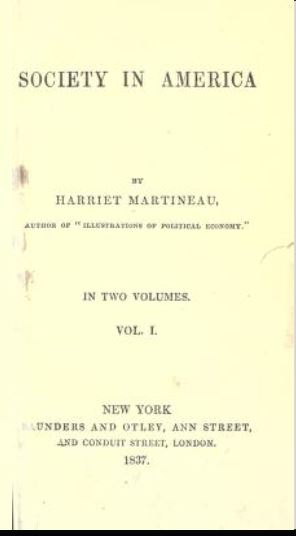
Martineau's 1837
overview of her
travels in the United States
For an extended analysis of this hypocrisy as it pertains to women, we can turn to Harriet Martinea's "Political Non-Existence of Women," written after her two-year journey throughout the country from 1834 to 1836. 

Everywhere she had traveled in the United States, Martineau was fêted, warmly recognized and welcomed as the great "lion of London," whose writings on politics and the economy were widely read and appreciated. She seems to have met everyone who was anyone, including James Madison, whom Martineau visited at Montpelier in 1835.

When she returned to England, Martineau wrote about her travels. An abolitionist, she had a lot to say about slavery in the United States. But in light of the current state of affairs for women in this country, newly returned to unequal status, I thought it would be most appropriate here to read what Martineau had to say about the status of women in the place where the Declaration of Independence had loudly proclaimed the equality of humankind.

Rather than my usual analysis, I'll quote here--with a link to the first volume of her two-volume Society in America (1837) so you can read more, if you're interested. (The "Political Non-Existence of Women" is Chapter 3, section 7.)

From "Political Non-Existence of Women"

One of the fundamental principles announced in the Declaration of Independence is, that governments derive their just powers from the consent of the governed. How can the political condition of women be reconciled with this?

Governments in the United States have power to tax women who hold property; to divorce them from their husbands; to fine, imprison, and execute them for certain offences. Whence do these governments derive their powers? They are not "just," as they are not derived from the consent of the women thus governed.

Governments in the United States have power to enslave certain women; and also to punish other women for inhuman treatment of such slaves. Neither of these powers are "just;" not being derived from the consent of the governed.

Governments decree to women in some States half their husbands' property; in others one-third. In some, a woman, on her marriage, is made to yield all her property to her husband; in others, to retain a portion, or the whole, in her own hands. Whence do governments derive the unjust power of thus disposing of property without the consent of the governed?

The democratic principle condemns all this as wrong; and requires the equal political representation of all rational beings. . . . 

The case is so plain that I might close it here; but it is interesting to inquire how so obvious a decision has been so evaded as to leave to women no political rights whatever. The question has been asked, from time to time, in more countries than one, how obedience to the laws can be required of women, when no woman has, either actually or virtually, given any assent to any law. No plausible answer has, as far as I can discover, been offered; for the good reason, that no plausible answer can be devised. The most principled democratic writers on government have on this subject sunk into fallacies, as disgraceful as any advocate of despotism has adduced. . . . 

[Thomas] Jefferson says,* "Were our State a pure democracy, in which all the inhabitants should meet together to transact all their business, there would yet be excluded from their deliberations,

"1. Infants, until arrived at years of discretion;

"2. Women, who, to prevent depravation of morals, and ambiguity of issue, could not mix promiscuously in the public meetings of men;

"3. Slaves, from whom the unfortunate state of things with us takes away the rights of will and of property."

If the slave disqualification, here assigned, were shifted up under the head of Women, their case would be nearer the truth than as it now stands. Woman's lack of will and of property, is more like the true cause of her exclusion from the representation, than that which is actually set down against her. As if there could be no means of conducting public affairs but by promiscuous meetings! As if there would be more danger in promiscuous meetings for political business than in such meetings for worship, for oratory, for music, for dramatic entertainments,—for any of the thousand transactions of civilized life! The plea is not worth another word.

Mill says, with regard to representation, in his Essay on Government, "One thing is pretty clear; that all those individuals, whose interests are involved in those of other individuals, may be struck off without inconvenience.... In this light, women may be regarded, the interest of almost all of whom is involved, either in that of their fathers or in that of their husbands."

The true democratic principle is, that no person's interests can be, or can be ascertained to be, identical with those of any other person. This allows the exclusion of none but incapables.

The word "almost," in Mr. Mill's second sentence, rescues women from the exclusion he proposes. As long as there are women who have neither husbands nor fathers, his proposition remains an absurdity.

The interests of women who have fathers and husbands can never be identical with theirs, while there is a necessity for laws to protect women against their husbands and fathers. This statement is not worth another word.

Some who desire that there should be an equality of property between men and women, oppose representation, on the ground that political duties would be incompatible with the other duties which women have to discharge. The reply to this is, that women are the best judges here. God has given time and power for the discharge of all duties; and, if he had not, it would be for women to decide which they would take, and which they would leave. But their guardians follow the ancient fashion of deciding what is best for their wards. The Emperor of Russia discovers when a coat of arms and title do not agree with a subject prince. The King of France early perceives that the air of Paris does not agree with a free-thinking foreigner. The English Tories feel the hardship that it would be to impose the franchise on every arti[s]an, busy as he is in getting his bread. The Georgian planter perceives the hardship that freedom would be to his slaves. And the best friends of half the human race peremptorily decide for them as to their rights, their duties, their feelings, their powers. In all these cases, the persons thus cared for feel that the abstract decision rests with themselves; that, though they may be compelled to submit, they need not acquiesce.

It is pleaded that half of the human race does acquiesce in the decision of the other half, as to their rights and duties. And some instances, not only of submission, but of acquiescence, there are. Forty years ago, the women of New Jersey went to the poll, and voted, at state elections. The general term, "inhabitants," stood unqualified;—as it will again, when the true democratic principle comes to be fully understood. A motion was made to correct the inadvertence; and it was done, as a matter of course; without any appeal, as far as I could learn, from the persons about to be injured. Such acquiescence proves nothing but the degradation of the injured party. It inspires the same emotions of pity as the supplication of the freed slave who kneels to his master to restore him to slavery, that he may have his animal wants supplied, without being troubled with human rights and duties. Acquiescence like this is an argument which cuts the wrong way for those who use it.

But this acquiescence is only partial; and, to give any semblance of strength to the plea, the acquiescence must be complete. I, for one, do not acquiesce. I declare that whatever obedience I yield to the laws of the society in which I live is a matter between, not the community and myself, but my judgment and my will. Any punishment inflicted on me for the breach of the laws, I should regard as so much gratuitous injury: for to those laws I have never, actually or virtually, assented. [emphasis added] I know that there are women in England who agree with me in this—I know that there are women in America who agree with me in this. The plea of acquiescence is invalidated by us. [emphasis added]

It is pleaded that, by enjoying the protection of some laws, women give their assent to all. This needs but a brief answer. Any protection thus conferred is, under woman's circumstances, a boon bestowed at the pleasure of those in whose power she is. A boon of any sort is no compensation for the privation of something else; nor can the enjoyment of it bind to the performance of anything to which it bears no relation. Because I, by favour, may procure the imprisonment of the thief who robs my house, am I, unrepresented, therefore bound not to smuggle French ribbons? The obligation not to smuggle has a widely different derivation.

I cannot enter upon the commonest order of pleas of all;—those which relate to the virtual influence of woman; her swaying the judgment and will of man through the heart; and so forth. One might as well try to dissect the morning mist. I knew a gentleman in America who told me how much rather he had be a woman than the man he is;—a professional man, a father, a citizen. He would give up all this for a woman's influence. I thought he was mated too soon. He should have married a lady, also of my acquaintance, who would not at all object to being a slave, if ever the blacks should have the upper hand; "it is so right that the one race should be subservient to the other!" Or rather,—I thought it a pity that the one could not be a woman, and the other a slave; so that an injured individual of each class might be exalted into their places, to fulfil and enjoy the duties and privileges which they despise, and, in despising, disgrace.

The truth is, that while there is much said about "the sphere of woman," two widely different notions are entertained of what is meant by the phrase. The narrow, and, to the ruling party, the more convenient notion is that sphere appointed by men, and bounded by their ideas of propriety;—a notion from which any and every woman may fairly dissent. The broad and true conception is of the sphere appointed by God, and bounded by the powers which he has bestowed. This commands the assent of man and woman; and only the question of powers remains to be proved.

That woman has power to represent her own interests, no one can deny till she has been tried. The modes need not be discussed here: they must vary with circumstances. The fearful and absurd images which are perpetually called up to perplex the question,—images of women on wool-sacks in England, and under canopies in America, have nothing to do with the matter. The principle being once established, the methods will follow, easily, naturally, and under a remarkable transmutation of the ludicrous into the sublime. The kings of Europe would have laughed mightily, two centuries ago, at the idea of a commoner, without robes, crown, or sceptre, stepping into the throne of a strong nation. Yet who dared to laugh when Washington's super-royal voice greeted the New World from the presidential chair, and the old world stood still to catch the echo?

The principle of the equal rights of both halves of the human race is all we have to do with here. It is the true democratic principle which can never be seriously controverted, and only for a short time evaded. Governments can derive their just powers only from the consent of the governed.

Happy Independence Day, all you lucky American women who are, as of now, no longer independent.


*Here Martineau cites "'Correspondence,' vol. iv. p. 295." To read Jefferson's letter in full for yourself, click here.